|
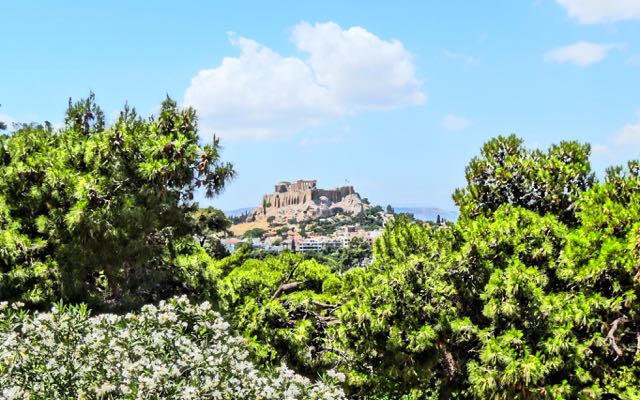 Athens ever-increasing traffic-free pedestrian streets and greenways are turning the center of the city into one of the
most liveable in Europe. The
Acropolis,
Thission, the
National Gardens,
Psiri, Gazi, Monastiraki, Syntagma, and the
Plaka are all
connected by greenway or pedestrian street while some steets like Athinas have had the sidewalks widened and the road narrowed to discourage traffic. These people-friendly zones are being
extended further and further. If you book a hotel in the right place there is no need for you to even see automobile traffic in Athens except to and from the airport or the port. And the best is yet to come. The plans for Athens is to make many of the major roads more like parks than streets and enable people to walk or ride their bikes safely and happily all over the city. Athens ever-increasing traffic-free pedestrian streets and greenways are turning the center of the city into one of the
most liveable in Europe. The
Acropolis,
Thission, the
National Gardens,
Psiri, Gazi, Monastiraki, Syntagma, and the
Plaka are all
connected by greenway or pedestrian street while some steets like Athinas have had the sidewalks widened and the road narrowed to discourage traffic. These people-friendly zones are being
extended further and further. If you book a hotel in the right place there is no need for you to even see automobile traffic in Athens except to and from the airport or the port. And the best is yet to come. The plans for Athens is to make many of the major roads more like parks than streets and enable people to walk or ride their bikes safely and happily all over the city.
|
|
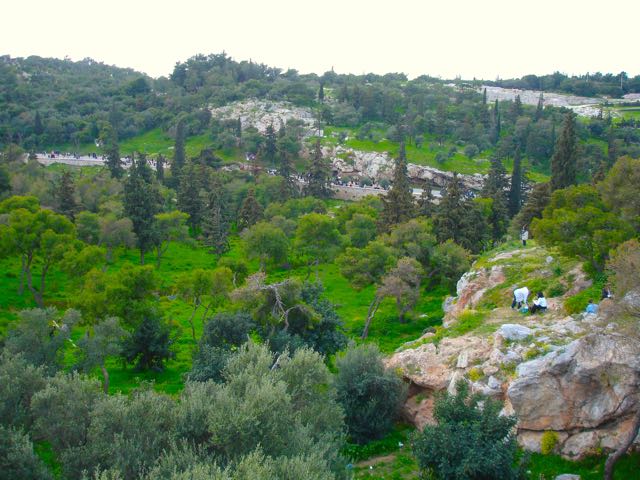 For such an unnatural setting as Athens, there is lots of open space and wildlife in the area
around the Acropolis. Much of it is free
and full of ancient ruins. There are miles of
pathways to walk on and in the spring when the
wildflowers are in bloom you can feel like you
are out in the country or walking through an
Athens that existed before the age of
apartment buildings and traffic. There is a
plan that is being carried out where all the
archaeological sites will be connected by
these wildlife areas and a series of
pedestrian streets and you can see much of
this coming into being on Dionysiou Areopagitou and Apostolou Pavlou, the roads that
separates the Acropolis from the neighborhoods
of Makriani and Thission, on the opposite side of the
hill from the Plaka. What used to be a very busy
street is now a pedestrian avenue and park with cafes and restaurants and even a horse drawn carriage. It begins across the street from Hadrian's Arch and the Temple of Olympian Zeus, goes past the Acropolis Museum and continues all the way to Monastiraki. For such an unnatural setting as Athens, there is lots of open space and wildlife in the area
around the Acropolis. Much of it is free
and full of ancient ruins. There are miles of
pathways to walk on and in the spring when the
wildflowers are in bloom you can feel like you
are out in the country or walking through an
Athens that existed before the age of
apartment buildings and traffic. There is a
plan that is being carried out where all the
archaeological sites will be connected by
these wildlife areas and a series of
pedestrian streets and you can see much of
this coming into being on Dionysiou Areopagitou and Apostolou Pavlou, the roads that
separates the Acropolis from the neighborhoods
of Makriani and Thission, on the opposite side of the
hill from the Plaka. What used to be a very busy
street is now a pedestrian avenue and park with cafes and restaurants and even a horse drawn carriage. It begins across the street from Hadrian's Arch and the Temple of Olympian Zeus, goes past the Acropolis Museum and continues all the way to Monastiraki.
|
|
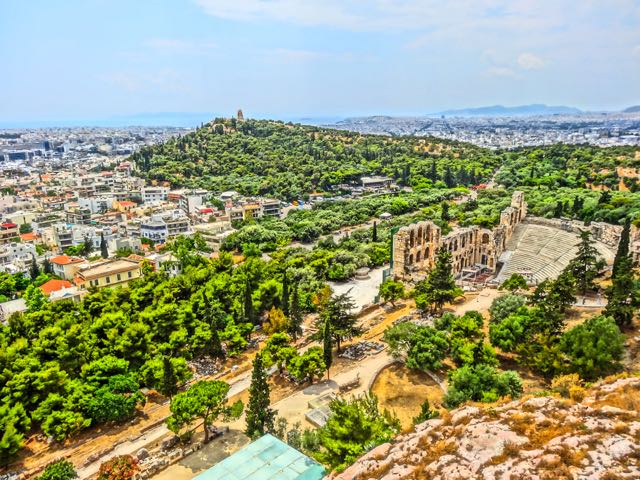 The entire area around the Acropolis
is like a
forest of olive and pine trees, with park benches, stray ancient columns and
stray dogs too. The south side between the Roman
Theater of Herod Atticus and the ancient
theater of Dionysious is covered in the price of admission to the Acropolis but a lot of the surrounding area is public forest and park and you don't have to pay anything to wander around and look at the wildlife. If you are a runner or jogger you will find this section of Athens to be a paradise of pathways and cobblestone streets and the only thing you have to worry about is bumping into other people during tourist seasons or on sunny days when most of Athens is out enjoying the
weather or holidays like kathari deftera when the area is full of Athenians. The entire area around the Acropolis
is like a
forest of olive and pine trees, with park benches, stray ancient columns and
stray dogs too. The south side between the Roman
Theater of Herod Atticus and the ancient
theater of Dionysious is covered in the price of admission to the Acropolis but a lot of the surrounding area is public forest and park and you don't have to pay anything to wander around and look at the wildlife. If you are a runner or jogger you will find this section of Athens to be a paradise of pathways and cobblestone streets and the only thing you have to worry about is bumping into other people during tourist seasons or on sunny days when most of Athens is out enjoying the
weather or holidays like kathari deftera when the area is full of Athenians.
|
|
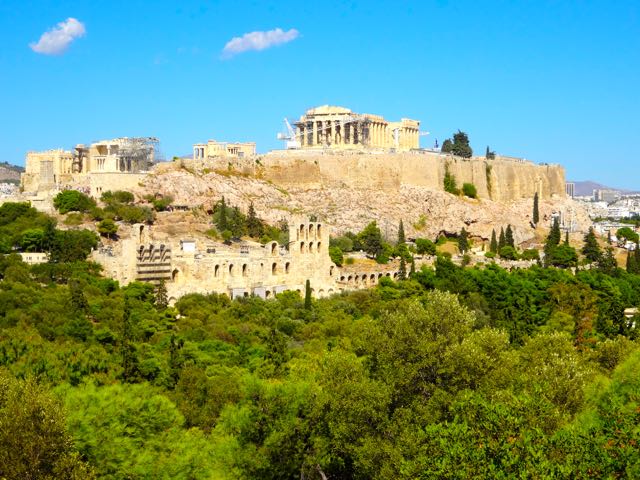 If you walk from the entrance to the
Acropolis down the hill bearing to your left
and across the street you can climb the hill
of Philopapou and spend hours wandering around
the forests. This is where you can see some of
the most impressive views of the Parthenon so
be sure to have your camera with you even if you have come here for a morning or evening run. There
are paths all over and this one section of
wilderness goes on for miles. There is a
quarry and a couple theaters, one for the Dora
Stratou Dancers and the other for the Athens
Sound and Light, and someone told me there is
a waterfall but I have yet to find it. If you take the paths down the west side of the hill you will come to the neighborhood of Petralona, an area of small streets, full of cafes and restaurants. If you walk from the entrance to the
Acropolis down the hill bearing to your left
and across the street you can climb the hill
of Philopapou and spend hours wandering around
the forests. This is where you can see some of
the most impressive views of the Parthenon so
be sure to have your camera with you even if you have come here for a morning or evening run. There
are paths all over and this one section of
wilderness goes on for miles. There is a
quarry and a couple theaters, one for the Dora
Stratou Dancers and the other for the Athens
Sound and Light, and someone told me there is
a waterfall but I have yet to find it. If you take the paths down the west side of the hill you will come to the neighborhood of Petralona, an area of small streets, full of cafes and restaurants.
|
|
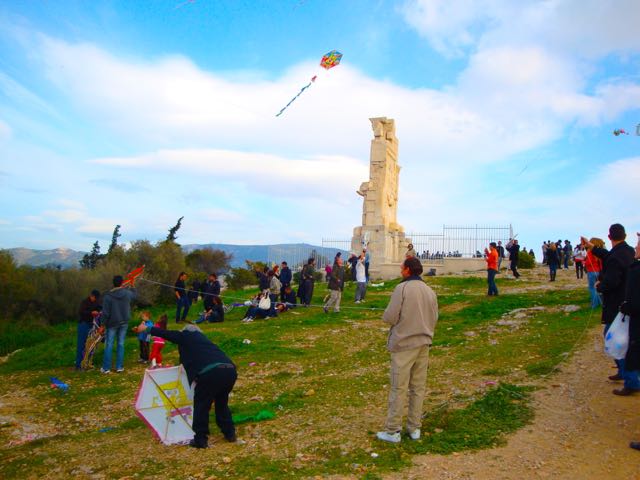 The monument on top of Filopapou was built
by the Romans in 114-116 AD in honor of Julius
Antiochus Philopappos, a prominent consul and
administrator and it is from here that you can
get some amazing views of the city. Come here on Clean Monday after Apokreas (Carnival) and the whole mountain top is full of people flying colorful kites and there is even some live music going on. (See My Apokreas Page for some photos). On your way to the top keep your eyes open for what is known as the Prison of Socrates, carved into the stone face of the mountain. Whether it actually was the
real prison
or not I don't know but it certainly looks like
it could have been so lets just allow that myth to continue. Actually the cave was a sanctuary of Pan. There are other caves in the rock, one of which was used to hide art and ancient artifacts from the Nazis during the occupation.
The monument on top of Filopapou was built
by the Romans in 114-116 AD in honor of Julius
Antiochus Philopappos, a prominent consul and
administrator and it is from here that you can
get some amazing views of the city. Come here on Clean Monday after Apokreas (Carnival) and the whole mountain top is full of people flying colorful kites and there is even some live music going on. (See My Apokreas Page for some photos). On your way to the top keep your eyes open for what is known as the Prison of Socrates, carved into the stone face of the mountain. Whether it actually was the
real prison
or not I don't know but it certainly looks like
it could have been so lets just allow that myth to continue. Actually the cave was a sanctuary of Pan. There are other caves in the rock, one of which was used to hide art and ancient artifacts from the Nazis during the occupation.
|
|
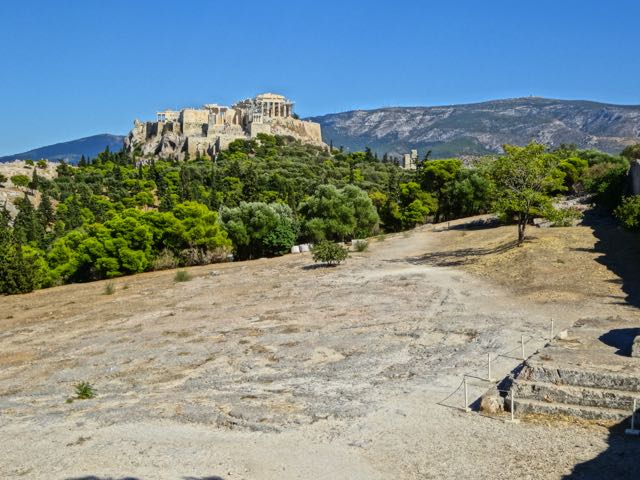 Pnyx Hill
which is next to Filopapou is considered the
birthplace of Democracy because this is where
the Athenians gathered to debate and govern
the state of Athens. Though Athens was the
first democracy there were problems that led
to it's downfall which may look familiar to
those of us who take an interest in current
events. Athenian democracy was a great step
foreword for mankind, however the rights of a
citizen did not apply to all. Women were not
recognized as citizens and there was a large
slave population who had no rights and did all
the hard work. But the key to the fall of
Athenian democracy was their denial of the
freedoms they enjoyed to the other city states
which were under its protection from the
Persian threat (which was more of a method to
scare their neighbors than it was an actual
threat). In the name of security, Athens built
up political and military hegemony over the
other Greek states, forcing them to make
sacrifices that benefited only Athens. This
led to thirty years of war with Sparta and in the end
Athenian power and democracy was
destroyed.
But the decisions that led up to the war and those that were made during the war including the disastrous decision to invade Syracuse were made at the flat section carved into the rock called the Pnyx or Pnika. Pnyx Hill
which is next to Filopapou is considered the
birthplace of Democracy because this is where
the Athenians gathered to debate and govern
the state of Athens. Though Athens was the
first democracy there were problems that led
to it's downfall which may look familiar to
those of us who take an interest in current
events. Athenian democracy was a great step
foreword for mankind, however the rights of a
citizen did not apply to all. Women were not
recognized as citizens and there was a large
slave population who had no rights and did all
the hard work. But the key to the fall of
Athenian democracy was their denial of the
freedoms they enjoyed to the other city states
which were under its protection from the
Persian threat (which was more of a method to
scare their neighbors than it was an actual
threat). In the name of security, Athens built
up political and military hegemony over the
other Greek states, forcing them to make
sacrifices that benefited only Athens. This
led to thirty years of war with Sparta and in the end
Athenian power and democracy was
destroyed.
But the decisions that led up to the war and those that were made during the war including the disastrous decision to invade Syracuse were made at the flat section carved into the rock called the Pnyx or Pnika.
|
|
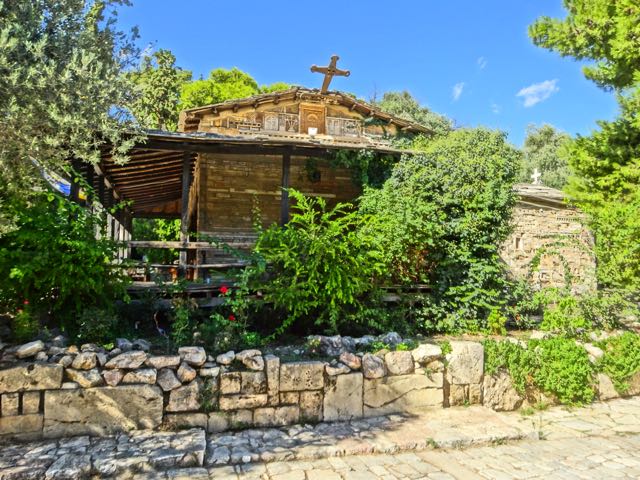 It is also on Pnyx Hill that you will find the
small church of Saint Dimitrios the
Bombardier. In 1645 Yusuf Aga, commander of
the Turkish garrison, planned to massacre
all the Christians of Athens while they
attended the celebration of Saint Dimitrios on
October 26th. He ordered all the churches of
the city closed so everyone would have to
attend the small church on Pnyx Hill, which he
would then bomb with all the gunpowder he
had collected and stored in the Propylea on
the Acropolis. The night before the
celebration there was a big storm and
lightning struck the Prolpylea, exploding the
gunpowder and killing Aga and most of his
family. From then on the church was known as
Agios Dimitrios Loumbardiaris. The church
contains a large number of carved marble
pieces as well as an unusual wooden
veranda. It is also on Pnyx Hill that you will find the
small church of Saint Dimitrios the
Bombardier. In 1645 Yusuf Aga, commander of
the Turkish garrison, planned to massacre
all the Christians of Athens while they
attended the celebration of Saint Dimitrios on
October 26th. He ordered all the churches of
the city closed so everyone would have to
attend the small church on Pnyx Hill, which he
would then bomb with all the gunpowder he
had collected and stored in the Propylea on
the Acropolis. The night before the
celebration there was a big storm and
lightning struck the Prolpylea, exploding the
gunpowder and killing Aga and most of his
family. From then on the church was known as
Agios Dimitrios Loumbardiaris. The church
contains a large number of carved marble
pieces as well as an unusual wooden
veranda.
|
|
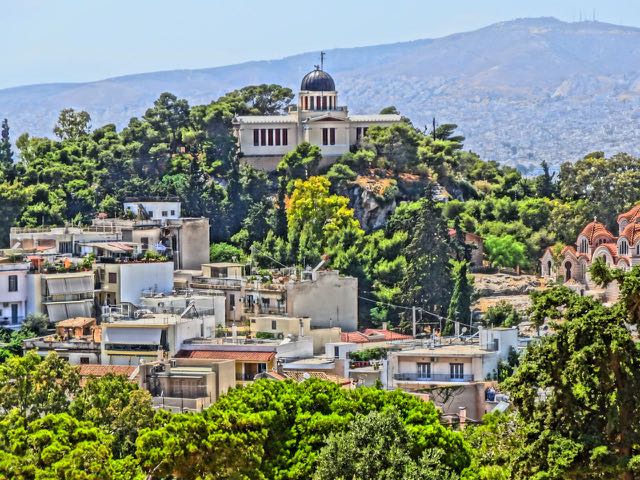 Next to
Pnyx hill is the Hill of the Nymphs, crowned
by the observatory and the church of
Agia Marina. It is believed that in ancient times
this was the Hill of Hyakinthos and the nymphs
were the yenethliai who protected women
in childbirth. Saint Marina is the
patron saint associated with childbirth
and the practice of bringing honey as an
offering to the nymphs was replaced by the
practice of changing and leaving old clothes
of sick children in the belief that by leaving
the clothes the illness would leave the child.
Some believe the nymphs are still active on
this hill.
The Hill of the Nymphs is the top of the neighborhood of Thission, a lively area which is full of pedestrian streets and outdoor cafes. Next to
Pnyx hill is the Hill of the Nymphs, crowned
by the observatory and the church of
Agia Marina. It is believed that in ancient times
this was the Hill of Hyakinthos and the nymphs
were the yenethliai who protected women
in childbirth. Saint Marina is the
patron saint associated with childbirth
and the practice of bringing honey as an
offering to the nymphs was replaced by the
practice of changing and leaving old clothes
of sick children in the belief that by leaving
the clothes the illness would leave the child.
Some believe the nymphs are still active on
this hill.
The Hill of the Nymphs is the top of the neighborhood of Thission, a lively area which is full of pedestrian streets and outdoor cafes. |
|
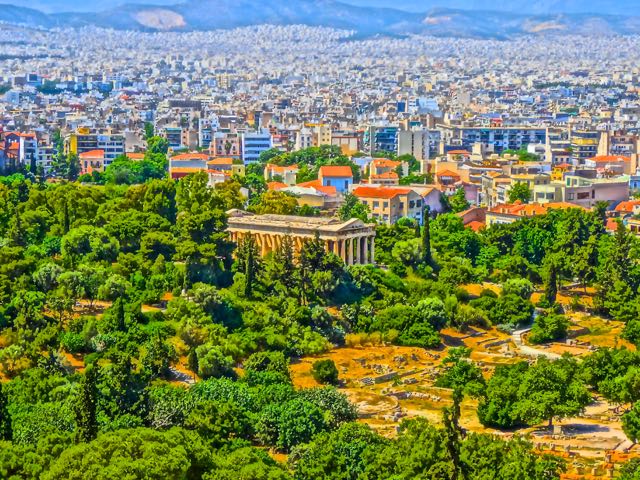 If instead of walking to your left when you
leave the Acropolis, you walk to your right
you will pass Aeropagus Hill and the famous
slippery steps. (In other words be careful).
There is a fantastic view of Athens from the
top of the rock and this is a popular spot for
watching the sunset over Pireaus. Below is the
Ancient Agora and the Temple of Hephaestus,
still intact and acres and acres of paths
through the ruins of the ancient market of
Athens. You can cut right though here and get
to the Monastiraki Flea Market if you want to
do some shopping. There is also a museum in
the impressive replica of the Stoa of Attalos,
the long building you can't help but notice
from the hill. This was the place we used to
go to be alone with our girlfriends or to do
other things that we did not want adults to
see us doing when we were high school students
in the late sixties.
If instead of walking to your left when you
leave the Acropolis, you walk to your right
you will pass Aeropagus Hill and the famous
slippery steps. (In other words be careful).
There is a fantastic view of Athens from the
top of the rock and this is a popular spot for
watching the sunset over Pireaus. Below is the
Ancient Agora and the Temple of Hephaestus,
still intact and acres and acres of paths
through the ruins of the ancient market of
Athens. You can cut right though here and get
to the Monastiraki Flea Market if you want to
do some shopping. There is also a museum in
the impressive replica of the Stoa of Attalos,
the long building you can't help but notice
from the hill. This was the place we used to
go to be alone with our girlfriends or to do
other things that we did not want adults to
see us doing when we were high school students
in the late sixties.
|
|
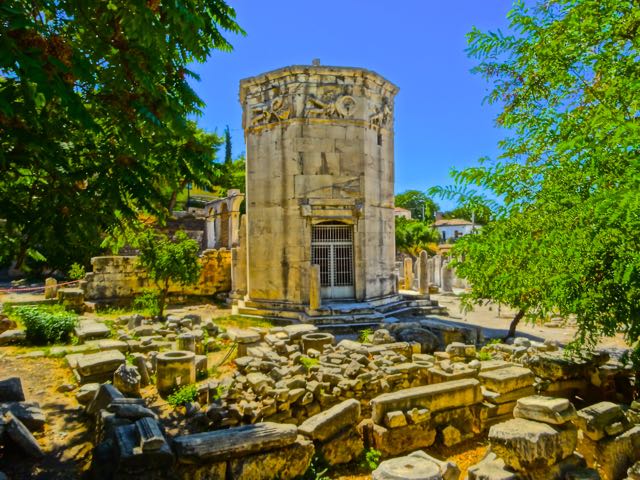 You are now among buildings and people but if you take the right steps your exposure to automobiles should be very minimal because most of Monastiraki and the Plaka are pedestrian streets. In fact the only thing you really have to be careful of is pedestrians,
and the occasional Happy Train ferrying tourists around. There are also several areas that may not be green in the summer but are in the winter, and are full of ancient ruins, again covered in the price of your ticket to the Acropolis. You have already gone through the Ancient Agora and now you can go through the Roman Agora with the famous Tower of the Winds. Also the archaeological site of Hadrian's Library begins at Monastiraki Square. You are now among buildings and people but if you take the right steps your exposure to automobiles should be very minimal because most of Monastiraki and the Plaka are pedestrian streets. In fact the only thing you really have to be careful of is pedestrians,
and the occasional Happy Train ferrying tourists around. There are also several areas that may not be green in the summer but are in the winter, and are full of ancient ruins, again covered in the price of your ticket to the Acropolis. You have already gone through the Ancient Agora and now you can go through the Roman Agora with the famous Tower of the Winds. Also the archaeological site of Hadrian's Library begins at Monastiraki Square.
|
|
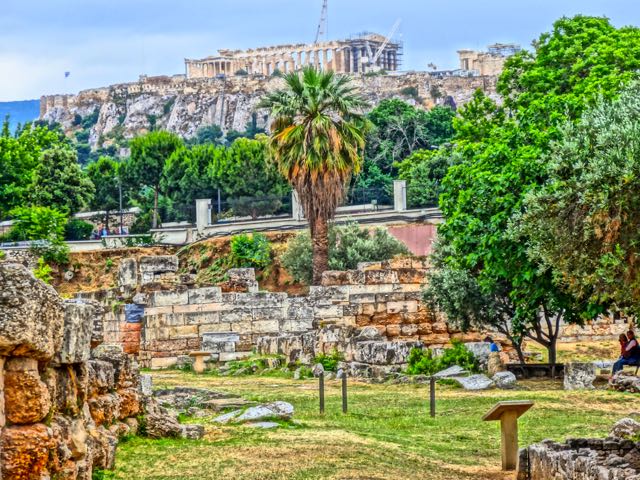 From Monastiraki Square you have a couple choices. You can turn your back to the Acropolis and walk to Ermou Street. If you go left for 2 blocks you will come to another pedestrian avenue that will bring you to the neaighborhood of Gazi,
the former city gas works, now a thriving center of nightlife with cafes, bars, restaurants and clubs and most of the streets are closed to automobile traffic. But this is better at night so instead stop halfway there to the Archaeological Site of Kerameikos, the ancient Cemetery of Athens and one of the most beautiful places in the city. Within the site are the ancient walls of Athens and the Sacred Gate which was only used by pilgrims from Eleusus using the sacred road to
and from that site during the annual procession. Nearby is the Dipylon gate which was the main entrance to the city and the area is rich in grave monuments and ancient walls and buildings. From Monastiraki Square you have a couple choices. You can turn your back to the Acropolis and walk to Ermou Street. If you go left for 2 blocks you will come to another pedestrian avenue that will bring you to the neaighborhood of Gazi,
the former city gas works, now a thriving center of nightlife with cafes, bars, restaurants and clubs and most of the streets are closed to automobile traffic. But this is better at night so instead stop halfway there to the Archaeological Site of Kerameikos, the ancient Cemetery of Athens and one of the most beautiful places in the city. Within the site are the ancient walls of Athens and the Sacred Gate which was only used by pilgrims from Eleusus using the sacred road to
and from that site during the annual procession. Nearby is the Dipylon gate which was the main entrance to the city and the area is rich in grave monuments and ancient walls and buildings.
|
|
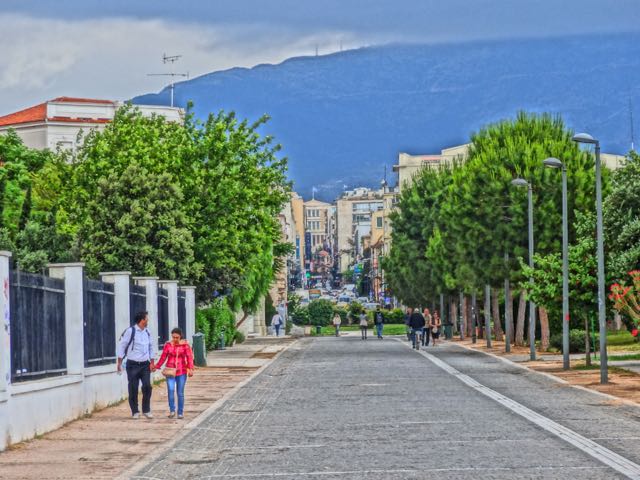 From Kerameikos to Syntagma Square it is a 20 minute walk up Ermou of which maybe only three blocks of it has cars on it. The rest is either park or pedestrian street. On the way you will pass the neighborhood of Psiri,
which is mostly pedestrian streets, Aeolou Street, another pedestrian shopping street that you can take past the City Market to within a half a block of Omonia Square. If you continue up Ermou you pass the famous old Church of Kapni Karea in the middle of Ermou street and many of the most famous shops in Athens because if you have read the Ermou Street page you will know that
this is where everybody comes to shop. At the very top of Ermou you will come to Syntagma Square and Greece's Parliament Building. Unless of
course you chose instead to make your way through the Plaka and avoid automobiles altogether. Either way you will find yourself on Amalias Avenue and all you have to do is cross it and you are in the National Gardens of Athens. From Kerameikos to Syntagma Square it is a 20 minute walk up Ermou of which maybe only three blocks of it has cars on it. The rest is either park or pedestrian street. On the way you will pass the neighborhood of Psiri,
which is mostly pedestrian streets, Aeolou Street, another pedestrian shopping street that you can take past the City Market to within a half a block of Omonia Square. If you continue up Ermou you pass the famous old Church of Kapni Karea in the middle of Ermou street and many of the most famous shops in Athens because if you have read the Ermou Street page you will know that
this is where everybody comes to shop. At the very top of Ermou you will come to Syntagma Square and Greece's Parliament Building. Unless of
course you chose instead to make your way through the Plaka and avoid automobiles altogether. Either way you will find yourself on Amalias Avenue and all you have to do is cross it and you are in the National Gardens of Athens.
|
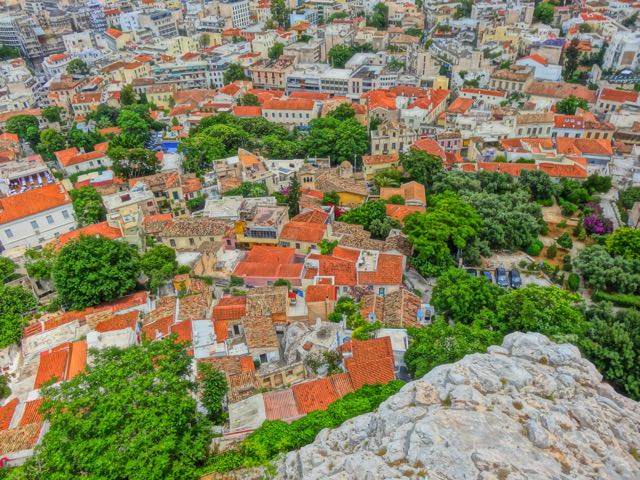 For those who decide to walk through the Plaka you will find the main shopping street of Adrianou is automobile free for most of the way and where it isn't the number of pedestrians make it unwise for anyone driving a car to enter. Turn right on almost any street, for example Mniscicleous, and the roads give way to stairs
and the buildings get older. Keep climbing and you find yourself amongst pine trees, Byzantine churches and stone streets and if you keep walking east you will be in the district of Anafiotika, a small village of white stone houses built by the people who came from the island of Anafi. You can wander around the narrow streets and get the feeling you are on a Greek island, despite the distant sounds of traffic below. Keep walking and you will be right below the flag on the west corner of the Acropolis with
a view of Mount Lykavettos and most of central Athens. For those who decide to walk through the Plaka you will find the main shopping street of Adrianou is automobile free for most of the way and where it isn't the number of pedestrians make it unwise for anyone driving a car to enter. Turn right on almost any street, for example Mniscicleous, and the roads give way to stairs
and the buildings get older. Keep climbing and you find yourself amongst pine trees, Byzantine churches and stone streets and if you keep walking east you will be in the district of Anafiotika, a small village of white stone houses built by the people who came from the island of Anafi. You can wander around the narrow streets and get the feeling you are on a Greek island, despite the distant sounds of traffic below. Keep walking and you will be right below the flag on the west corner of the Acropolis with
a view of Mount Lykavettos and most of central Athens. |
|
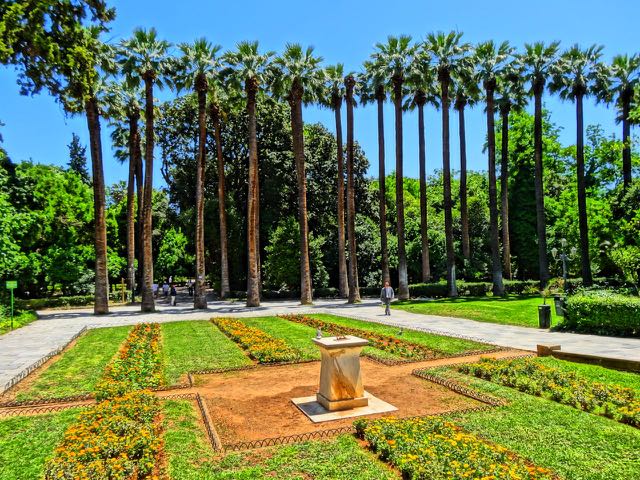 When you get to
the
National Gardens
you will find yourself
in a tropical paradise of plants and trees
that were at one time the private gardens of
the King of Greece but now belong to the
people. In fact it was in these very gardens
in the year of 1920 that King Alexander was
bitten by a monkey and died, an event that
altered the future in a way that made it one
of the most important events in Greek history,
leading to the expulsion of over a million
Greeks from Asia Minor and creating the Athens
that we know of today. But that is a long
story that should be covered elsewhere. There
are no more moneys in the National Gardens and
no more kings in Greece but there is plenty of
wildlife, especially if you like ducks. There are other animals too, a few birds, a mountain goat and plenty of cats. But the ducks rule the National Gardens. Also if you like plants and trees you will be very happy wandering around in here. If you
pass through the gardens to Herod Atticus
street you can see the old Palace, still
guarded by the Evzones now home to whatever lucky person happens to be Prime Minister. When you get to
the
National Gardens
you will find yourself
in a tropical paradise of plants and trees
that were at one time the private gardens of
the King of Greece but now belong to the
people. In fact it was in these very gardens
in the year of 1920 that King Alexander was
bitten by a monkey and died, an event that
altered the future in a way that made it one
of the most important events in Greek history,
leading to the expulsion of over a million
Greeks from Asia Minor and creating the Athens
that we know of today. But that is a long
story that should be covered elsewhere. There
are no more moneys in the National Gardens and
no more kings in Greece but there is plenty of
wildlife, especially if you like ducks. There are other animals too, a few birds, a mountain goat and plenty of cats. But the ducks rule the National Gardens. Also if you like plants and trees you will be very happy wandering around in here. If you
pass through the gardens to Herod Atticus
street you can see the old Palace, still
guarded by the Evzones now home to whatever lucky person happens to be Prime Minister. |
|
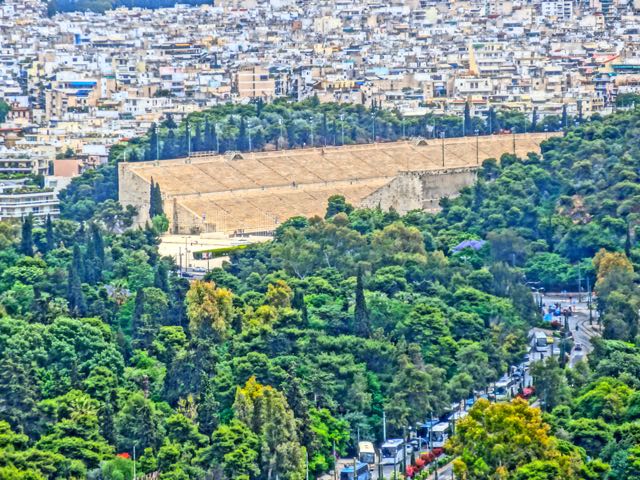 By going right down Herod Atticus or if you
are in the gardens by following the signs
towards Zappion you can pass through another
area of trees, plants and flowers by the famous Zappion Building, cross busy
Vas Konstantinos or Vas. Olgas streets and be at the
first Olympic Stadium. Called Panathinaiko Stadium, it is also known as the Kallimarmaro (Καλλιμάρμαρο), which means "beautifully marbled" and is the world's only stadium made entirely of marble. It was built in 1896 in the footprint of the ancient stadium and is surrounded by forests. If you walk to the top
of the Stadium you will realize that it is
level with the top of Arditos hill where
health-minded Athenians and the occasional tourist who has read my website jog in the late
afternoon. Even if you don't feel like jogging
there is a spectacular view of the Acropolis
from up on the top of the stadium. Below there is a cafe
which serves excellent frappes and espresso
and the area around it is where the children
from the neighborhood come to play. This was the stadium used in the 2004 Olympics for archery and the end of the annual historic Athens Classic Marathon where they run the original route from Marathon by Pheidippides in 490 BC when he warned the Athenians that the Persians had invaded.
By going right down Herod Atticus or if you
are in the gardens by following the signs
towards Zappion you can pass through another
area of trees, plants and flowers by the famous Zappion Building, cross busy
Vas Konstantinos or Vas. Olgas streets and be at the
first Olympic Stadium. Called Panathinaiko Stadium, it is also known as the Kallimarmaro (Καλλιμάρμαρο), which means "beautifully marbled" and is the world's only stadium made entirely of marble. It was built in 1896 in the footprint of the ancient stadium and is surrounded by forests. If you walk to the top
of the Stadium you will realize that it is
level with the top of Arditos hill where
health-minded Athenians and the occasional tourist who has read my website jog in the late
afternoon. Even if you don't feel like jogging
there is a spectacular view of the Acropolis
from up on the top of the stadium. Below there is a cafe
which serves excellent frappes and espresso
and the area around it is where the children
from the neighborhood come to play. This was the stadium used in the 2004 Olympics for archery and the end of the annual historic Athens Classic Marathon where they run the original route from Marathon by Pheidippides in 490 BC when he warned the Athenians that the Persians had invaded.
|
|
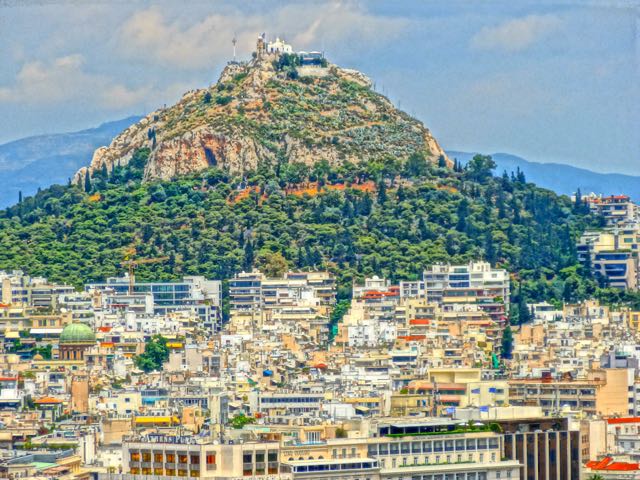 From the stadium you will notice a large
mountain across the way, opposite the
Acropolis. If you walk straight up Herod
Atticus street and keep walking through
Kolonaki
, or just cut through the park, you will
eventually come to Mount Lykabettos which is
actually two mountains and miles and miles of
trails and several cafes at the top or near it
. If you don't feel like climbing up you can
take a train to the top and walk down. There
is a large variety of plants and trees and the
views are spectacular, especially at sunset.
There is a church at the very top and there is
also a theater that has rock concerts during
the summer. (I saw James Brown, Roy Harper and a very strange incarnation of The Byrds here. One night I arrived in Athens and I could hear Peter Gabriel from the city below while he was playing at Lykavettos.) There are also two nice little parks in Kolonaki, Platia Dexamini which is the ancient Roman cistern that provided water to the city, and Kolonaki Square, named for the small ancient column that was found there and still stands. If you have decided you are not up for the trek to the top of Lykavettos and
are standing at the stadium still wondering what to do, you can take a left on Vassilias Olgas and walk towards the Temple of Olympian Zeus and Hadrian's Arch which is where this page began. From the stadium you will notice a large
mountain across the way, opposite the
Acropolis. If you walk straight up Herod
Atticus street and keep walking through
Kolonaki
, or just cut through the park, you will
eventually come to Mount Lykabettos which is
actually two mountains and miles and miles of
trails and several cafes at the top or near it
. If you don't feel like climbing up you can
take a train to the top and walk down. There
is a large variety of plants and trees and the
views are spectacular, especially at sunset.
There is a church at the very top and there is
also a theater that has rock concerts during
the summer. (I saw James Brown, Roy Harper and a very strange incarnation of The Byrds here. One night I arrived in Athens and I could hear Peter Gabriel from the city below while he was playing at Lykavettos.) There are also two nice little parks in Kolonaki, Platia Dexamini which is the ancient Roman cistern that provided water to the city, and Kolonaki Square, named for the small ancient column that was found there and still stands. If you have decided you are not up for the trek to the top of Lykavettos and
are standing at the stadium still wondering what to do, you can take a left on Vassilias Olgas and walk towards the Temple of Olympian Zeus and Hadrian's Arch which is where this page began. |
|
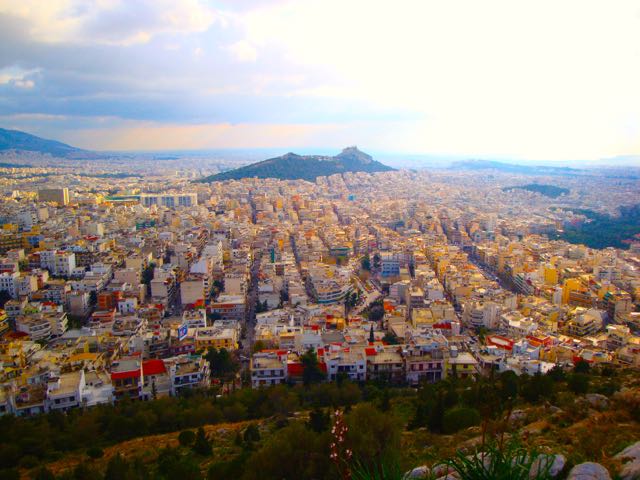 There are other green areas that are not connected to the archaeological parks of central Athens. On the other side of Patission is the mountain
known as Tourkovouna. Unlike these other areas, the mountain, or mountains that are at the
top of Galatsi, is wooded and full of farms
and houses and has a very third-world
atmosphere. Not exactly a tourist destination
and without a car difficult to get to, the
mountain is covered in trees and the views are
spectacular though the abundance of radio and
phone antennae made me a little nervous about
micro-waves. But there is a big park, a sports
center and even a movie theater on the way to
the top, and lots of barking dogs. You may want to save this until you make friends with an Athenian who has a car and knows his way around. There are other green areas that are not connected to the archaeological parks of central Athens. On the other side of Patission is the mountain
known as Tourkovouna. Unlike these other areas, the mountain, or mountains that are at the
top of Galatsi, is wooded and full of farms
and houses and has a very third-world
atmosphere. Not exactly a tourist destination
and without a car difficult to get to, the
mountain is covered in trees and the views are
spectacular though the abundance of radio and
phone antennae made me a little nervous about
micro-waves. But there is a big park, a sports
center and even a movie theater on the way to
the top, and lots of barking dogs. You may want to save this until you make friends with an Athenian who has a car and knows his way around.
|
|
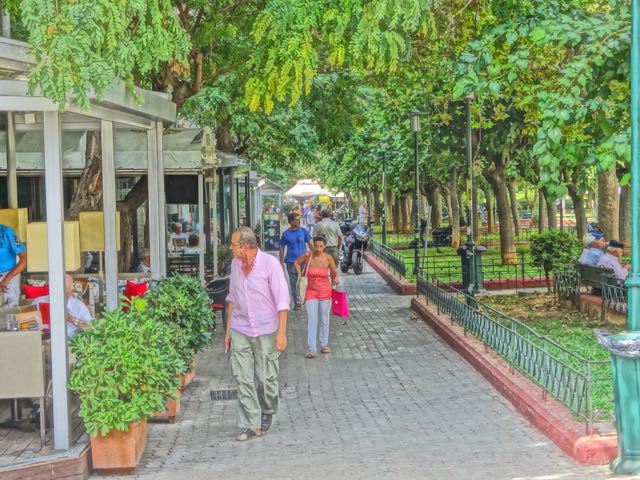 You could visit Pedion Areos, which is actually the biggest park in Athens, but right now is sort of in transition, to put it nicely. But beyond it is my favorite green area, called Fokionos Negri, formerly a large avenue that came down the mountain
of Tourkovouna and is now a pedestrian area and park full of tall trees, gardens, fountains, grass and lots of cafes and restaurants. It is perhaps
the most popular dog walking area in Athens and it seems like people either moved here so their dogs would be happy or they lived here and decided this would be a nice place to have a dog. The plan is to connect Fokionos Negri with the rest of the Athens greenways and pedestrian streets though this may have been temporarily derailed. So for now if you want to come here you have to take a taxi, a trolley (the 2, 4 or 9 go to Kanaris Square as does the 035 blue bus) or walk up Patission. But honestly anyone should
be satisfied with what is available in central Athens and if you are just looking for green you don't need to take a bus or a taxi to find it. You could visit Pedion Areos, which is actually the biggest park in Athens, but right now is sort of in transition, to put it nicely. But beyond it is my favorite green area, called Fokionos Negri, formerly a large avenue that came down the mountain
of Tourkovouna and is now a pedestrian area and park full of tall trees, gardens, fountains, grass and lots of cafes and restaurants. It is perhaps
the most popular dog walking area in Athens and it seems like people either moved here so their dogs would be happy or they lived here and decided this would be a nice place to have a dog. The plan is to connect Fokionos Negri with the rest of the Athens greenways and pedestrian streets though this may have been temporarily derailed. So for now if you want to come here you have to take a taxi, a trolley (the 2, 4 or 9 go to Kanaris Square as does the 035 blue bus) or walk up Patission. But honestly anyone should
be satisfied with what is available in central Athens and if you are just looking for green you don't need to take a bus or a taxi to find it.
The next time someone tells you that Athens
is nothing but a concrete jungle you can give
them a good argument.
|
Hotels in or Bordering Athens Greenways
|
|
If you have come this far you are probably wondering where you can stay in order to take advantage of the pedestrian streets and greenways of Athens. Most any hotel in downtown Athens will have you within a block or two of a park or pedestrian street. The Grande Bretagne, King
George and the Plaza
Hotel are right on Syntagma Square and thus connected though you have to cross a busy street to get to it. The Hotel Electra is on traffic free Ermou Street and the Athens Cypria is within half a block on a smaller pedestrian street. Nearby are the Hotel Athens Diamond Plus and the Athens Status Suites. In the Plaka you can stay at the Electra Palace, Hotel Adonis, Hotel Adams, Hotel
Adrian, Hotel
Phaedra and Hotel Nefeli and never see a car traveling at more than 5mph. In Makrianni the Hotel Hera, the Athens Was Hotel,
Parthenon
Hotel, Athens Studios and the Herodion Hotel are all on or within half a block of a pedestrian street that will connect you to the network. In Monastiraki the 360
Hotel Apartments and the A is for Athens are right on the square. For backpackers the Safestay Athens Hotel is on Ag Theklas street in the automobile free neighborhood of Psiri. The Hotel
Attalos is also in Psiri and a block from Aeolou Street and the Hotel Tempi and the Emporikon Athens Hotel are both on Platia Irini Square. In Thission the Phidias Hotel is right on Apostolos Pavlou Street 250 metres
from the Acropolis and the Hotel Acropolis View is just across from Filopapou Hill on a small pedestrian steet.
|
|