|
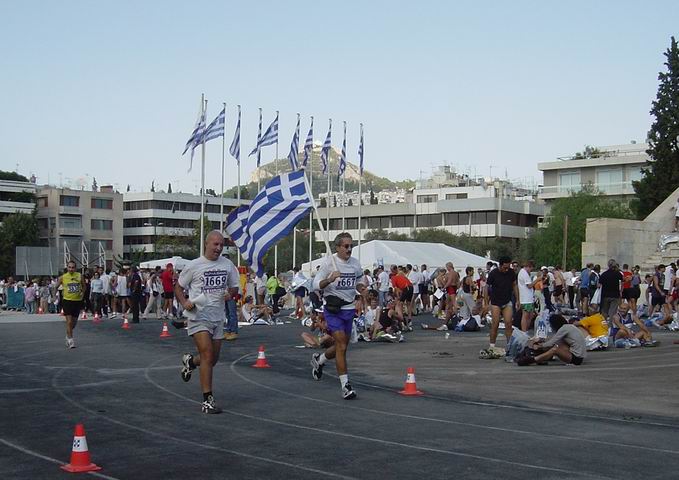 Everyone knows the Boston Marathon and anyone who has not run in the New York Marathon has at least seen it on TV. These are the two most popular long-distance races, not surprising since they are in two of the most popular cities in the USA.
But few
people have
heard of THE Marathon and fewer have actually run it. For while the New York and Boston races can draw over twenty thousand runners and a million spectators, THE Marathon may have three thousand on a good year and the runners almost always outnumber the spectators. Everyone knows the Boston Marathon and anyone who has not run in the New York Marathon has at least seen it on TV. These are the two most popular long-distance races, not surprising since they are in two of the most popular cities in the USA.
But few
people have
heard of THE Marathon and fewer have actually run it. For while the New York and Boston races can draw over twenty thousand runners and a million spectators, THE Marathon may have three thousand on a good year and the runners almost always outnumber the spectators.
THE Marathon is of course the Athens Classic Marathon, the route run by the runner Pheidippides in 490 BC, to tell the people of Athens that the Persians, who had landed there with an enormous army that should have been able to pulverize the Athenian defenders, had been defeated. The Athens Marathon is said to be one of the toughest, following a course that begins by the sea near the ancient battleground, climbing the base of Mount Pendeli and ending
on the
plains of Attika, now the center of Athens, at the old marble Stadium, built for the first modern Olympics in 1896. THE Marathon takes on even more meaning as it is dedicated to the memory of noted Greek peace activist, 1930s track star and physician and parliamentary deputy, Grigoris Lambrakis, whose shocking and politically motivated 1963 assassination in Thessaloniki, brought down the Karamanlis government and inspired film director Costa-Gavras' "Z" in 1969.
|
|
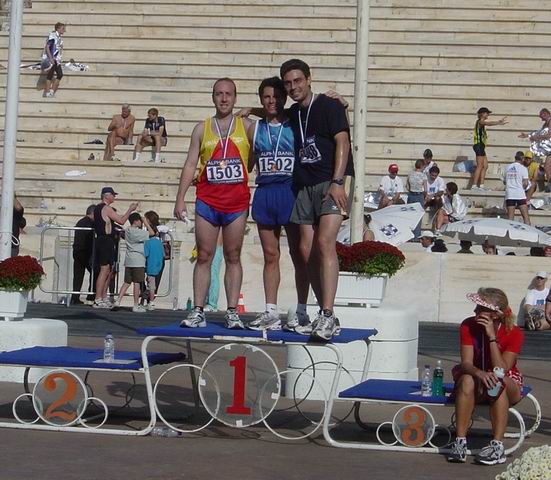 Sunday November 2nd was a warm and sunny day, more like late summer than
early winter (In Greece the word winter seems to mean not summer.
Though you can have many summer-like days in the winter.) We woke up early in
the Hotel Attalos and went to the breakfast room for coffee and after a walk through
the Sunday Flea Market to the Terina Cafe to plan our coverage of THE Marathon.
Because it was a race I needed a small and mobile crew, in this case my brother
David who happened to be in Athens to make contacts for his sailboat charter
company, and was happy to be a part of this event. As we sat in Terina we tried
to calculate when we would have to be at the Olympic Stadium to photograph the
finish. First of all how long does it take to run a Marathon? Four hours? Three
hours? Seven hours? We really had no idea. David, who is a lot smarter than
me came up with a formula. How long does it take to run a mile? Let's say the
world record is 3 minutes. (Or is it 2?) Let's say 4 just to be safe.
Let's double it because you can't run THE Marathon or any Marathon at full
speed. That makes 8. Multiply the number 8 by the number of miles in the
Marathon which was 28 and the answer was 224. Divide 224 by 60 and the
answer was 373 So if we show up at the finish line three hours and seventy-three
minutes (which is actually four hours and thirteen minutes) after the start of the race we can get our photos and our story. What
time did the race begin though? David remembered that traffic was going to be
closed today on the Marathon road at 8:30. That must be the starting time! (My
brother would make a fine investigative reporter.) Sunday November 2nd was a warm and sunny day, more like late summer than
early winter (In Greece the word winter seems to mean not summer.
Though you can have many summer-like days in the winter.) We woke up early in
the Hotel Attalos and went to the breakfast room for coffee and after a walk through
the Sunday Flea Market to the Terina Cafe to plan our coverage of THE Marathon.
Because it was a race I needed a small and mobile crew, in this case my brother
David who happened to be in Athens to make contacts for his sailboat charter
company, and was happy to be a part of this event. As we sat in Terina we tried
to calculate when we would have to be at the Olympic Stadium to photograph the
finish. First of all how long does it take to run a Marathon? Four hours? Three
hours? Seven hours? We really had no idea. David, who is a lot smarter than
me came up with a formula. How long does it take to run a mile? Let's say the
world record is 3 minutes. (Or is it 2?) Let's say 4 just to be safe.
Let's double it because you can't run THE Marathon or any Marathon at full
speed. That makes 8. Multiply the number 8 by the number of miles in the
Marathon which was 28 and the answer was 224. Divide 224 by 60 and the
answer was 373 So if we show up at the finish line three hours and seventy-three
minutes (which is actually four hours and thirteen minutes) after the start of the race we can get our photos and our story. What
time did the race begin though? David remembered that traffic was going to be
closed today on the Marathon road at 8:30. That must be the starting time! (My
brother would make a fine investigative reporter.)
|
|
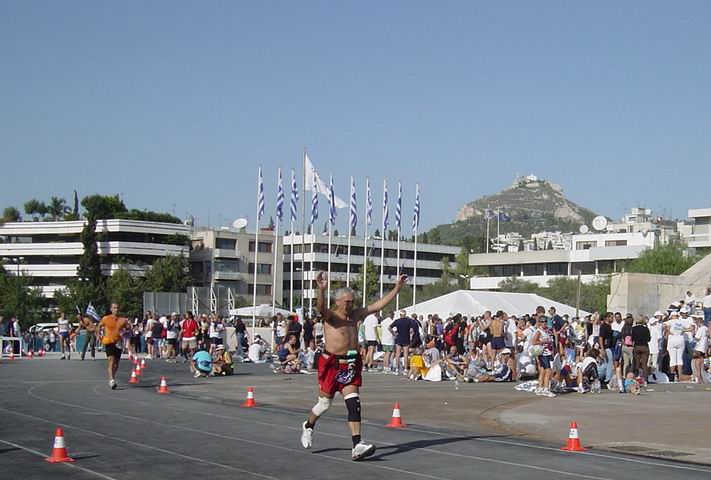 We sat around congratulating ourselves for being so clever. Sure we could
have just gone to the website for THE Marathon but that would be too easy. We
were a little more hard-nosed than your average reporter. The internet is for
wimps. All we had to do is be at the finish line at noon, half an hour from
now, which gave us enough time for another cup of coffee. We were joined
by our pal Nikos who had spotted us in the cafe table filled square at the bottom
of Adrianou Street. We sat around congratulating ourselves for being so clever. Sure we could
have just gone to the website for THE Marathon but that would be too easy. We
were a little more hard-nosed than your average reporter. The internet is for
wimps. All we had to do is be at the finish line at noon, half an hour from
now, which gave us enough time for another cup of coffee. We were joined
by our pal Nikos who had spotted us in the cafe table filled square at the bottom
of Adrianou Street.
"What are you doing today?" he asked us.
"We
are covering THE Marathon for Matt's website!" my brother said proudly.
"Ahh.
It's over you know. A Tanzanian has won."
We looked at each other. Could
our calculations have been so off? Where did we go wrong?
Niko went on. "There
were seven Kenyans and two Greeks in the first ten!"
We were shocked.
This was no record-breaking Tanzanian speed demon who had taken us by surprise.
We had missed at least the first ten runners. In the world of Sports Journalism
we had 'blown the story'. The winners had entered the stadium two and a half
hours after the race had started, which meant our calculation of three hours
and seventy-three minutes was wrong!
|
|
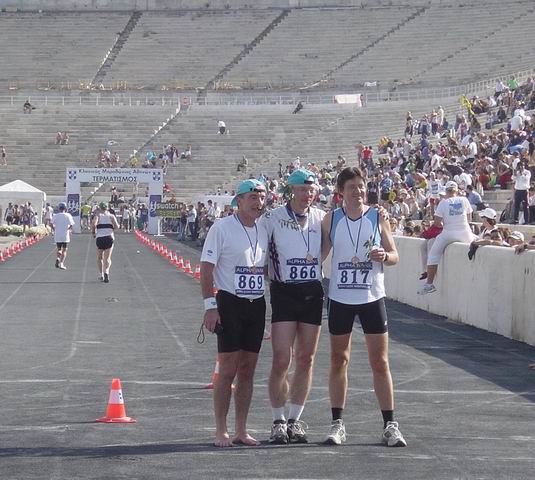 By the time we got to the Zappion we knew Nikos had been right. There were
large luxury buses parked on the street and tired runners hobbling towards them,
some being helped by their friends. Many of them were Japanese. Not a Tanzanian
or Kenyan in sight. The winners were probably already on their way to their
next Marathon and we had not even reached the stadium. As we approached the
intersection of Herod Atticus and Vassileos Konstantinos a ray of hope. There
were still runners arriving at the finish line. Not the finely tuned professional
athletes who run these races the way college students go from party to party
on Halloween to collect first prizes for ingenious costumes. The runners who
were finishing the race at the 4 hour mark were people like you and me.
Average people with normal bodies who knew they had no chance of winning
and did not care. They just wanted to run THE Marathon and to finish the race
no matter how long it took. I realized that if we had been in the stadium when the winners arrived we
would have probably gotten bored and left by now and not been on hand to see
the real heroes of the race. The people who were not so athletically endowed.
There were runners with leg-braces. There were runners with disabilities.
There were runners in their seventies or maybe their eighties. There were runners
who looked like they were more out of shape than me and I could not run a
Marathon even if it was from my house, downhill to the local taverna a block
away. And every person who ran, walked or hobbled into the stadium was met with
enthusiastic applause from the spectators who stuck around until the clock ran
out at six hours. By the time we got to the Zappion we knew Nikos had been right. There were
large luxury buses parked on the street and tired runners hobbling towards them,
some being helped by their friends. Many of them were Japanese. Not a Tanzanian
or Kenyan in sight. The winners were probably already on their way to their
next Marathon and we had not even reached the stadium. As we approached the
intersection of Herod Atticus and Vassileos Konstantinos a ray of hope. There
were still runners arriving at the finish line. Not the finely tuned professional
athletes who run these races the way college students go from party to party
on Halloween to collect first prizes for ingenious costumes. The runners who
were finishing the race at the 4 hour mark were people like you and me.
Average people with normal bodies who knew they had no chance of winning
and did not care. They just wanted to run THE Marathon and to finish the race
no matter how long it took. I realized that if we had been in the stadium when the winners arrived we
would have probably gotten bored and left by now and not been on hand to see
the real heroes of the race. The people who were not so athletically endowed.
There were runners with leg-braces. There were runners with disabilities.
There were runners in their seventies or maybe their eighties. There were runners
who looked like they were more out of shape than me and I could not run a
Marathon even if it was from my house, downhill to the local taverna a block
away. And every person who ran, walked or hobbled into the stadium was met with
enthusiastic applause from the spectators who stuck around until the clock ran
out at six hours.
|
|
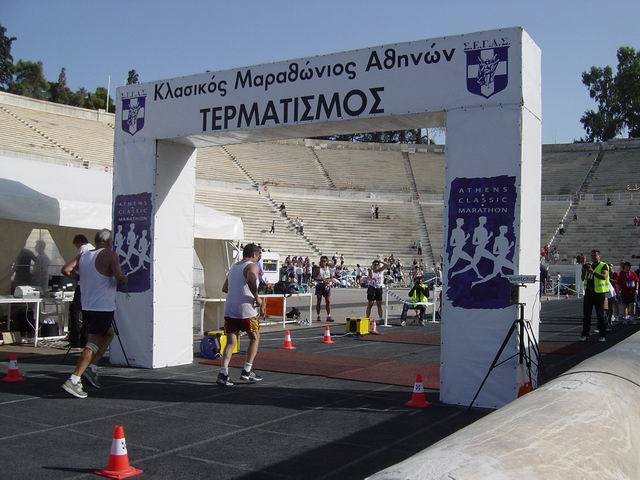 I spoke to some of the people who had finished the race. Some had never run
a Marathon before. Those that had said it was one of, if not THE toughest Marathon
they had ever run, with the unseasonably hot weather, the hills (mountains really)
and the fact that there were four porta-potties for 4,000 people. (This equation
is a lot easier. One toilet for every thousand people). What was particularly
encouraging was the fact that this event, which received little attention in
the past, actually drew thousands of spectators who lined the route and cheered
the runners as they passed, and the large group that was on hand at the finish.
There were a few problems. The police had opened the roads after the last runner
had passed and since a car is usually faster than a human, runners ended up
competing with the traffic and getting stuck at intersections. It also meant
that the vehicle with the street clothes for the runners was stuck in Marathon
behind the flood of vehicle traffic that had been released from their tethers.
When the clothes finally arrived at the stadium they were dumped on the
pavement and runners had to find their own in the hundreds of plastic bags which
is like trying to find the proverbial needle-in-the-haystack or your luggage
on the carrousel at the old Athens airport. This was the only real embarrassment
(besides the 4 toilets for 4000 people) and one that probably won't happen again.
Especially since the organizer of the event resigned because of it. (Though
he got another shot as Athletics Competition Manager for the Athens 2004 Olympics). I spoke to some of the people who had finished the race. Some had never run
a Marathon before. Those that had said it was one of, if not THE toughest Marathon
they had ever run, with the unseasonably hot weather, the hills (mountains really)
and the fact that there were four porta-potties for 4,000 people. (This equation
is a lot easier. One toilet for every thousand people). What was particularly
encouraging was the fact that this event, which received little attention in
the past, actually drew thousands of spectators who lined the route and cheered
the runners as they passed, and the large group that was on hand at the finish.
There were a few problems. The police had opened the roads after the last runner
had passed and since a car is usually faster than a human, runners ended up
competing with the traffic and getting stuck at intersections. It also meant
that the vehicle with the street clothes for the runners was stuck in Marathon
behind the flood of vehicle traffic that had been released from their tethers.
When the clothes finally arrived at the stadium they were dumped on the
pavement and runners had to find their own in the hundreds of plastic bags which
is like trying to find the proverbial needle-in-the-haystack or your luggage
on the carrousel at the old Athens airport. This was the only real embarrassment
(besides the 4 toilets for 4000 people) and one that probably won't happen again.
Especially since the organizer of the event resigned because of it. (Though
he got another shot as Athletics Competition Manager for the Athens 2004 Olympics).
|
|
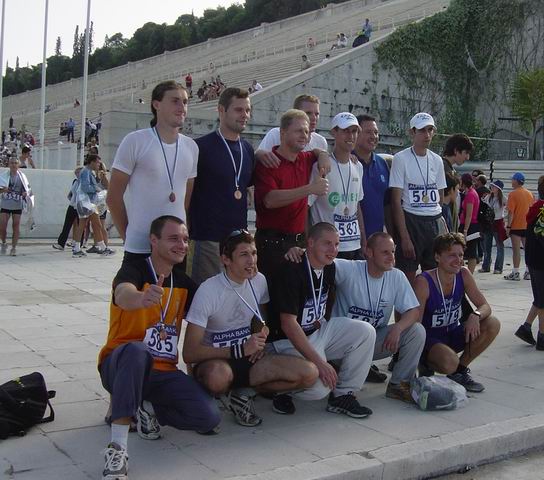 That evening in the Hotel Attalos we turned on the TV to CNN. "Here
it is" I called out to Andrea, watching the African runner leading the
pack. But what were these skyscrapers? This isn't Athens. It's New York City!
Once again Athens has been overshadowed by the west. As the first few runners
crossed the finish line with exhausted but happy expressions I thought of my
heroes of THE Marathon. They had the same expressions though they had finished
in the bottom two thousand instead of the first ten. But this was not a race
through the five boroughs of a relatively flat New York. They had run the same
route the ancient runner had taken to tell the Athenians of the miracle victory
when defeat would have changed history. From the ancient battlefield and over
Mount Pendeli to the broad avenues of modern Athens it was like a race through
history. That evening in the Hotel Attalos we turned on the TV to CNN. "Here
it is" I called out to Andrea, watching the African runner leading the
pack. But what were these skyscrapers? This isn't Athens. It's New York City!
Once again Athens has been overshadowed by the west. As the first few runners
crossed the finish line with exhausted but happy expressions I thought of my
heroes of THE Marathon. They had the same expressions though they had finished
in the bottom two thousand instead of the first ten. But this was not a race
through the five boroughs of a relatively flat New York. They had run the same
route the ancient runner had taken to tell the Athenians of the miracle victory
when defeat would have changed history. From the ancient battlefield and over
Mount Pendeli to the broad avenues of modern Athens it was like a race through
history.
They had run in THE MARATHON.
Read Athens Marathon Testimonial
|
|
|
Help Support Matt's Greece Guides
Do you enjoy using my site? Have you found it entertaining as well as useful? If so please show your appreciation by booking hotels through the travel agencies and the links found on my Hotels of Greece site. The small commission I make on the bookings enable me to keep working and in most cases you won't find them any cheaper by searching elsewhere.
You can find
hotels in Greece by location, price, whether or not it has a swimming pool, and see photos and reviews by using this link to booking.com which also contributes to my website when you book. If you are appreciative of all the free information you get on my websites you can also send
a donation through Paypal or Venmo
Join Matt Barrett's Greece Travel Guides Group on Facebook for comments, photos and other fun stuff. If you enjoy this website please share it with your friends on Facebook and other social media.
|