A Trip to the Argolis with George the Famous
Taxi Driver
It is easy
when you spend time in Athens to get lazy, but
there is nothing like a tour to Myceneae,
Epidavros, Corinth and Nafplion with George the Famous Taxi driver to
get me feeling like I am a real travel
writer
|
|
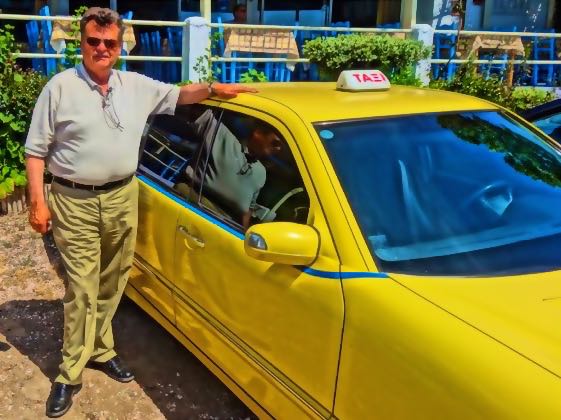 There is nothing like a trip with George the
Famous Taxi driver to shake me from my torpor and
rescue me from my bad habits. If it were up to me
I would hang out in cafes all day and take a nice
siesta in the afternoon to store up my energy to
go out at night with my friends, eating, drinking
and conversing 'til the wee hours of morning. For
me this is life at it's finest and if it were not
for the fact that after awhile this lifestyle
seems to run me down I think I would do it all the
time. But luckily for me I know George and when I
see myself falling into familiar patterns I can
call him up and if he has no customers that day I
ask him if he wants to go for a ride. He always
says yes. Why shouldn't he? He is my friend and he
also knows that if I happen to write about a
journey and it ends up on my web site it will mean
more customers for him. But I think he actually
enjoys taking trips with me. He knows that I know
Greece and it gives him an opportunity to show
someone who knows Greece, how much he knows about
it. Plus I think he is really proud of the way he
does his job and likes to show off a little bit,
and I know he likes to show off his Mercedes.
There is nothing like a trip with George the
Famous Taxi driver to shake me from my torpor and
rescue me from my bad habits. If it were up to me
I would hang out in cafes all day and take a nice
siesta in the afternoon to store up my energy to
go out at night with my friends, eating, drinking
and conversing 'til the wee hours of morning. For
me this is life at it's finest and if it were not
for the fact that after awhile this lifestyle
seems to run me down I think I would do it all the
time. But luckily for me I know George and when I
see myself falling into familiar patterns I can
call him up and if he has no customers that day I
ask him if he wants to go for a ride. He always
says yes. Why shouldn't he? He is my friend and he
also knows that if I happen to write about a
journey and it ends up on my web site it will mean
more customers for him. But I think he actually
enjoys taking trips with me. He knows that I know
Greece and it gives him an opportunity to show
someone who knows Greece, how much he knows about
it. Plus I think he is really proud of the way he
does his job and likes to show off a little bit,
and I know he likes to show off his Mercedes.
|
|
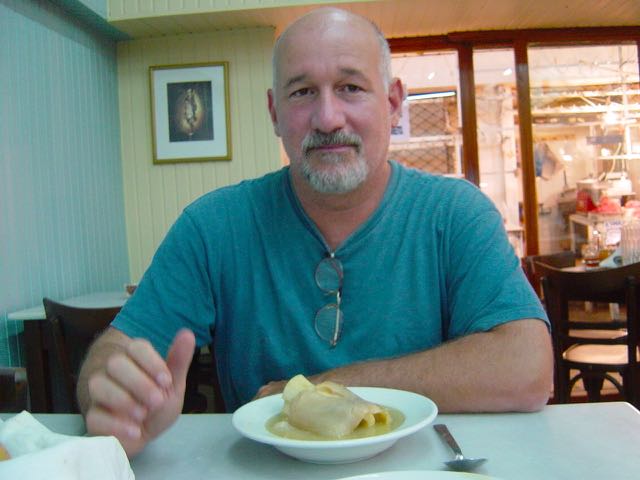 The only problem with me calling George about
doing a trip the next day has to do with the
transitory nature of human consciousness. Am I
losing you? Well, when I call George up from some
taverna because I am suddenly inspired that I have
to see Myceneae tomorrow because the weather man
promises a beautiful sunny day, there is a part of
me that is sort of hoping he says he is busy with
a customer. Because even though at that moment I
can think of nothing more wonderful than climbing
through the ruins of Agamemnon's palace, the
realist in me knows that some of this romanticism
is the wine talking to me and come
tomorrow that same wine may be saying something
different, like stay in bed or I need coffee.
The longer I stay out with my friends, the less
chance I will be happy, running carefree among the
ancient stones. The more I drink tonight, the more
of a chore tomorrow will be. The only problem with me calling George about
doing a trip the next day has to do with the
transitory nature of human consciousness. Am I
losing you? Well, when I call George up from some
taverna because I am suddenly inspired that I have
to see Myceneae tomorrow because the weather man
promises a beautiful sunny day, there is a part of
me that is sort of hoping he says he is busy with
a customer. Because even though at that moment I
can think of nothing more wonderful than climbing
through the ruins of Agamemnon's palace, the
realist in me knows that some of this romanticism
is the wine talking to me and come
tomorrow that same wine may be saying something
different, like stay in bed or I need coffee.
The longer I stay out with my friends, the less
chance I will be happy, running carefree among the
ancient stones. The more I drink tonight, the more
of a chore tomorrow will be.
But, George
had no plans for the following day and agreed
to meet me at the
Attalos Hotel at 9am so I was committed. I hung up my cell
phone and the next time my glass of wine
emptied I filled it with half wine and half
soda water. I did this for the rest of the
night and went to bed thinking I would be in
good shape for the trip if I could stop
burping long enough to fall asleep.
And if I felt a little ragged I could wake up a little earlier and go to the restaurant at the Meat Market and have a bowl of patsa or podi like the real working class people do when they need to recover.
|
|
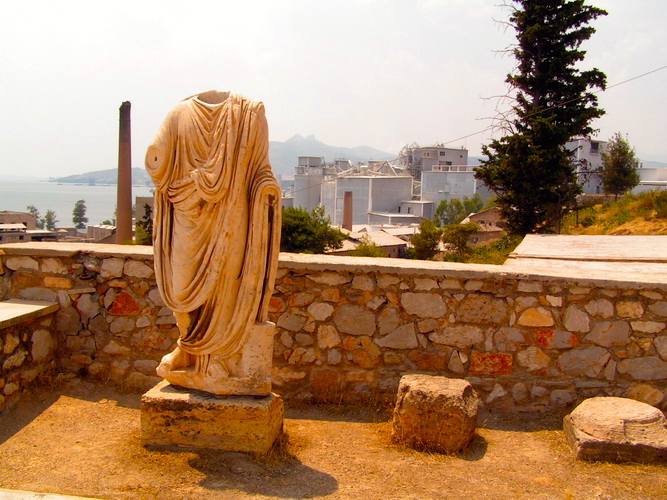 I was up at 8:30 feeling energised and adventurous, had a cup of Attalos coffee
and was on the road with George by two minutes
after nine. There was hardly any traffic and
in no time at all we were out of Athens and
passing the shipyards and refineries of
Elefsina, location of the Ancient Elefsinain Mysteries, one of the most important archaeological sites and museums
and now home to an unfortunate population
forced to breathe the foulest air in Greece in
an area that makes Linden, New Jersey look
like Yellowstone National Park. Further on we
pass the town of Megara, the chicken capital
of Greece with thousands of abandoned
hen-houses. I am falling asleep but I try to
pretend I am just looking out the window and
when George talks to me I respond as quickly
and as accurately as I am able so he does not
think he is the only one enjoying the
trip. I was up at 8:30 feeling energised and adventurous, had a cup of Attalos coffee
and was on the road with George by two minutes
after nine. There was hardly any traffic and
in no time at all we were out of Athens and
passing the shipyards and refineries of
Elefsina, location of the Ancient Elefsinain Mysteries, one of the most important archaeological sites and museums
and now home to an unfortunate population
forced to breathe the foulest air in Greece in
an area that makes Linden, New Jersey look
like Yellowstone National Park. Further on we
pass the town of Megara, the chicken capital
of Greece with thousands of abandoned
hen-houses. I am falling asleep but I try to
pretend I am just looking out the window and
when George talks to me I respond as quickly
and as accurately as I am able so he does not
think he is the only one enjoying the
trip.
|
First Stop: Corinth
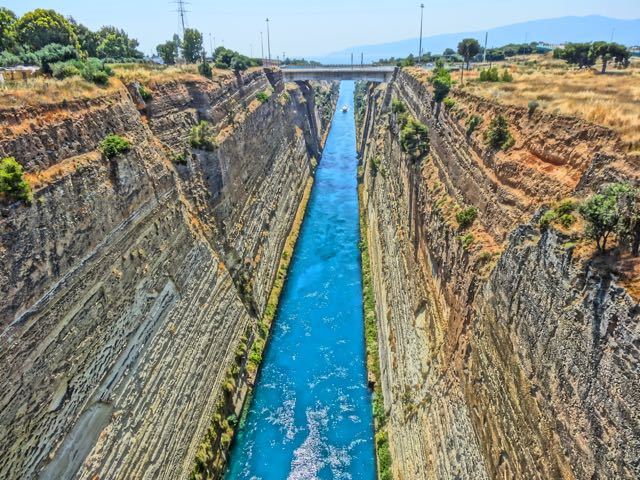 It is difficult for me to go over the
Corinth
Canal
and not
stop to walk across the old bridge and look
towards either end. To me the canal is no less
an amazing feat than the Parthenon. Started by
the Emperor Nero in 67 AD and completed by a
French company in 1893, the canal is 6 km long
and cut through solid rock. If I am lucky
there is a ship passing through while I am on
the bridge. This picture is taken from the
old bridge that George uses because you can stop and get out and walk across it, unlike the National Road bridge that most people use and don't even know they have gone over the canal. It is off this bridge that people now bungee-jump. You can see posters for the company that does it when you stop here. There are also some cafes and tourist shops that have seen better days since once they built the National Road and the new bridge most of the tourist and long distance buses have stopped coming here.
It is difficult for me to go over the
Corinth
Canal
and not
stop to walk across the old bridge and look
towards either end. To me the canal is no less
an amazing feat than the Parthenon. Started by
the Emperor Nero in 67 AD and completed by a
French company in 1893, the canal is 6 km long
and cut through solid rock. If I am lucky
there is a ship passing through while I am on
the bridge. This picture is taken from the
old bridge that George uses because you can stop and get out and walk across it, unlike the National Road bridge that most people use and don't even know they have gone over the canal. It is off this bridge that people now bungee-jump. You can see posters for the company that does it when you stop here. There are also some cafes and tourist shops that have seen better days since once they built the National Road and the new bridge most of the tourist and long distance buses have stopped coming here.
|
|
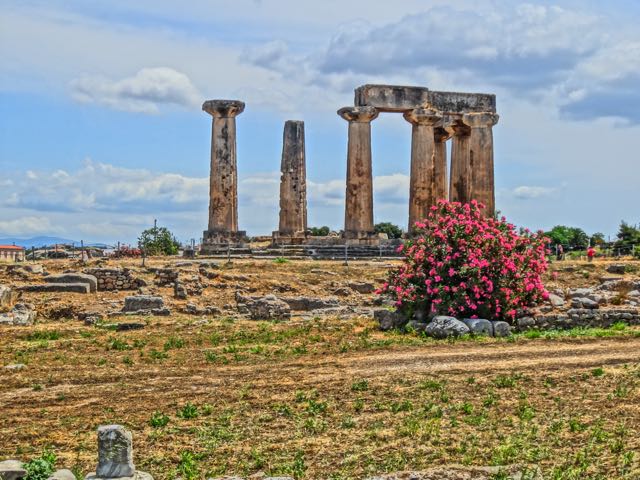 From the canal we drive through the ruins
of
Ancient
Corinth. I get out of the car and take a couple
pictures, just like I did when George and I
went to Nafplio for the day last Easter. One
of these days I really must walk around the
site and get to know it a little better. This
point is driven home to me when I realize I
took the exact same photo from the same spot
last year. But it
was
taken with
a different camera. For those of you who read The Bible, as you know Corinth is where Saint Paul spoke to the Corinthians and it is for that reason many Christians have it on their places to visit list. There is a pretty good museum and the ruins are interesting but if you are coming to Greece to see the place where Paul spoke to the Corinthians you may be a little disappointed since it will take you about 20 minutes to see everything. Luckily there are more ruins in Ancient Isthmia, which also has a nice museum
and George is happy to stop there too.
From the canal we drive through the ruins
of
Ancient
Corinth. I get out of the car and take a couple
pictures, just like I did when George and I
went to Nafplio for the day last Easter. One
of these days I really must walk around the
site and get to know it a little better. This
point is driven home to me when I realize I
took the exact same photo from the same spot
last year. But it
was
taken with
a different camera. For those of you who read The Bible, as you know Corinth is where Saint Paul spoke to the Corinthians and it is for that reason many Christians have it on their places to visit list. There is a pretty good museum and the ruins are interesting but if you are coming to Greece to see the place where Paul spoke to the Corinthians you may be a little disappointed since it will take you about 20 minutes to see everything. Luckily there are more ruins in Ancient Isthmia, which also has a nice museum
and George is happy to stop there too.
|
|
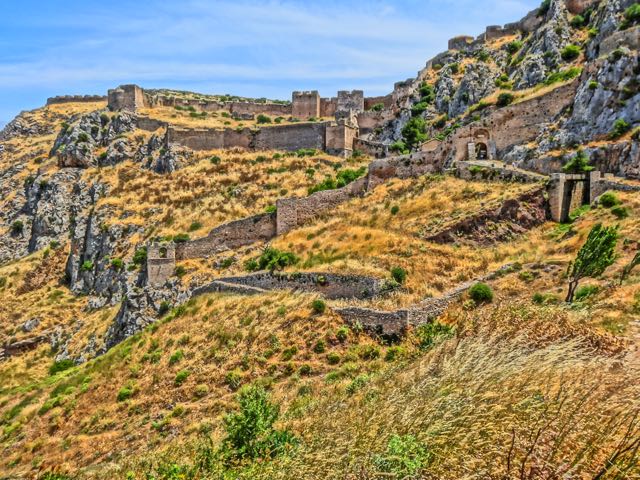 The ruins of Acrocorinth, the Acropolis of Corinth, can be seen from miles away and
is the
favorite archaeological site of my archaeologist friend Stuart
Thorne and climbing to the top is one of my
objectives of the day. But when we get to the
small parking area in front of the entrance I
realize that George has no intention of
climbing with me. The ruins of Acrocorinth, the Acropolis of Corinth, can be seen from miles away and
is the
favorite archaeological site of my archaeologist friend Stuart
Thorne and climbing to the top is one of my
objectives of the day. But when we get to the
small parking area in front of the entrance I
realize that George has no intention of
climbing with me.
"Are you crazy, Matthew? Do you know how
many times I climb this thing?"
So I set off alone, through the
impressive gates and up as high as I can go
before I start feeling like last night's
retsina is re-entering my bloodstream and last
night's kokoretsi feels like a piece of lead
that has somehow become lodged in my digestive
system. I climb high enough to see a beautiful
view of the Peloponessos but I know that if I
want to see the entire isthmus of Corinth I am
going to have to climb a lot higher. It is a
perfect situation for taking pictures. I am
the only person on the mountain. The sun is
shining and the grass is green so I really
should take advantage and keep going, but now
my heart is starting to beat faster and I am
feeling more mortal than usual.
|
|
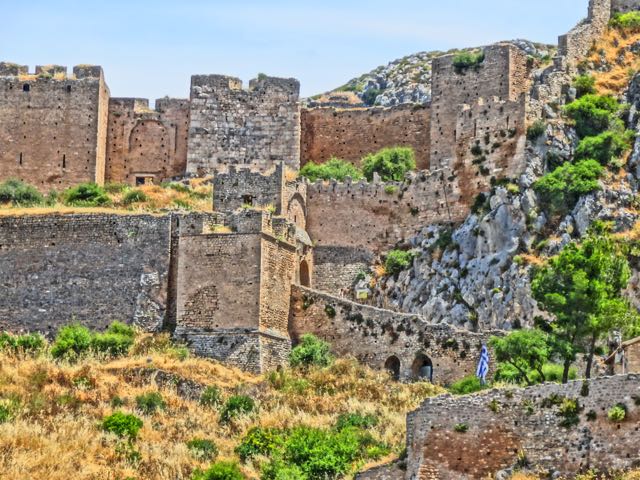 Luckily I am saved from my uncertain destiny
by the arrival of a tour bus full of Romanian
high school students who begin walking up the
path to the fortress. I realize that if I want
to take any photos without Romanians in them I
have to take them now and put my climb on hold
for the next time I visit Acrocorinth. There
are ruins of an ancient temple of Aphrodite at
the top but the most impressive thing about
the site besides the fantastic views is the gate. So
don't feel like you have to climb to the top
of Acrocorinth. Take a look at the gate, get a
few pictures, climb high enough to see the
view and then move on.
Luckily I am saved from my uncertain destiny
by the arrival of a tour bus full of Romanian
high school students who begin walking up the
path to the fortress. I realize that if I want
to take any photos without Romanians in them I
have to take them now and put my climb on hold
for the next time I visit Acrocorinth. There
are ruins of an ancient temple of Aphrodite at
the top but the most impressive thing about
the site besides the fantastic views is the gate. So
don't feel like you have to climb to the top
of Acrocorinth. Take a look at the gate, get a
few pictures, climb high enough to see the
view and then move on.
George and I drive back down the mountain,
past an old Turkish fountain and through the
village of Archaia Corinthos, eventually
getting on the road to the Argolis, an area
known for being the Florida of Europe because
of all the oranges it exports.
|
Ancient Myceneae
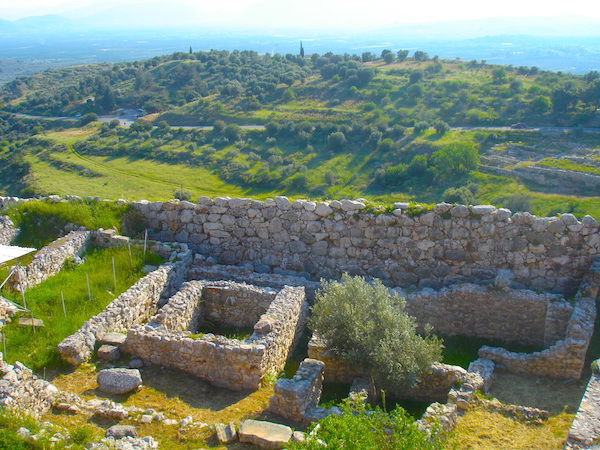 After about half an hour we come to the turn off
for ancient
Mycenae, passing first through the modern town of Mycenae
with its tourist shops and restaurants with giant
parking lots to accommodate tour buses, all empty
since few tourists come to Greece in January. But
when we get to the ancient site there are two
buses. One group is a Spanish tour and the other is
an American high school. People are spread all over
the ruins and I feel self conscious standing there
waiting for American students to get out of the
frame for a good shot. But even with the people
there Mycenae is impressive, especially at this
time of the year with the grass growing and the
winter wildflowers in bloom and green everywhere
you look. It is like finding Roman ruins in
Ireland. In the summer the grass will be gone,
dried to death by the sun and trampled by
thousands of foreign feet.
After about half an hour we come to the turn off
for ancient
Mycenae, passing first through the modern town of Mycenae
with its tourist shops and restaurants with giant
parking lots to accommodate tour buses, all empty
since few tourists come to Greece in January. But
when we get to the ancient site there are two
buses. One group is a Spanish tour and the other is
an American high school. People are spread all over
the ruins and I feel self conscious standing there
waiting for American students to get out of the
frame for a good shot. But even with the people
there Mycenae is impressive, especially at this
time of the year with the grass growing and the
winter wildflowers in bloom and green everywhere
you look. It is like finding Roman ruins in
Ireland. In the summer the grass will be gone,
dried to death by the sun and trampled by
thousands of foreign feet.
|
|
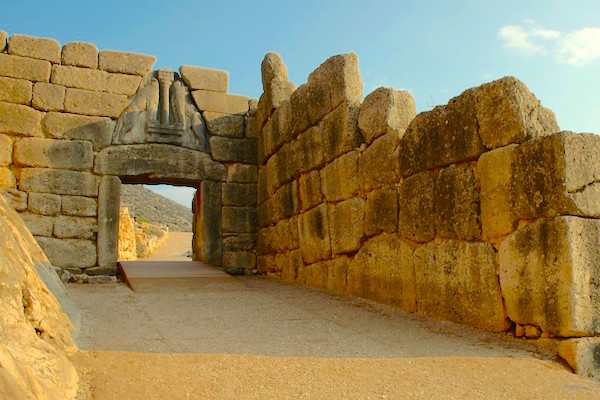 Like Acrocorinth the most interesting part of
Mycenae is the gate, here known as the Lion's
Gate because of the relief of the two lions
above the entranceway and said to be the
insignia of the Royal House of Atreus. To the
right is an impressive big circle with the
unimpressive name of Grave Circle A which were
excavated in 1874 by Henreich Schlieman and
the treasures put in the National Museum of
Athens. This was where he found the ancient
mask which he called the Mask of Agamemnon but
turned out to be the face of an unknown king
from a period 300 years earlier . But romantic
that Schlieman was, he sent a telegram to the
king of Greece that said "I have gazed upon
the face of Agamemnon." That mask is probably
one of the most recognized ancient artifacts
in the world and is still unofficially known
as the mask of Agamemnon while the ancient
king whose face is now known to millions is as
anonymous as the guy who picks up the litter
around the site. Like Acrocorinth the most interesting part of
Mycenae is the gate, here known as the Lion's
Gate because of the relief of the two lions
above the entranceway and said to be the
insignia of the Royal House of Atreus. To the
right is an impressive big circle with the
unimpressive name of Grave Circle A which were
excavated in 1874 by Henreich Schlieman and
the treasures put in the National Museum of
Athens. This was where he found the ancient
mask which he called the Mask of Agamemnon but
turned out to be the face of an unknown king
from a period 300 years earlier . But romantic
that Schlieman was, he sent a telegram to the
king of Greece that said "I have gazed upon
the face of Agamemnon." That mask is probably
one of the most recognized ancient artifacts
in the world and is still unofficially known
as the mask of Agamemnon while the ancient
king whose face is now known to millions is as
anonymous as the guy who picks up the litter
around the site.
The rest of Myceneae is interesting if you
know what you are looking at but if not it
looks like a bunch of rocks and walls and
floors. So take the time to read some of the
material available in guidebooks or sold at
the little shop on the site. They give away
free brochures that tell you what it is you
are looking at, or what it was. There is also
a plan of Mycenae that you can buy that has a
reconstruction of the site and if you have
that you will be pretty impressed. But even if
you don't the view is spectacular and climbing
to the top of Mycenae is nowhere near as
difficult as climbing Acrocorinth.
|
|
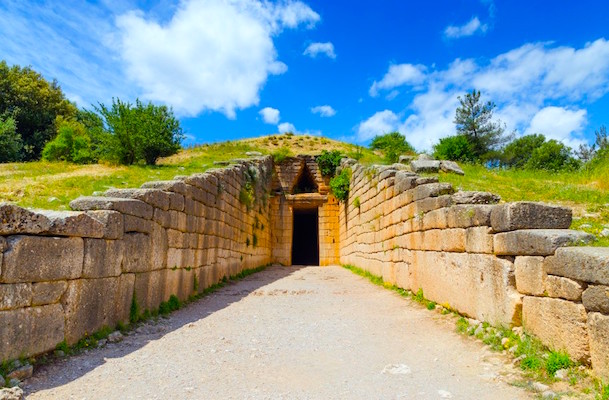 Down the road from Mycenae is the
Treasury
of Atreus or Tomb of Agememnon
which I
found to be the most impressive part of
ancient Mycenae. You walk through a passageway
into an enormous bee-hive tomb dug into the
ground. This is known as a tholos tomb and
this was the way the ancient Mycenaeans began
to bury their dead after the 15th century BC.
Further down the road is Grave Circle B and
the tholos tombs of Aegisthus and
Clytaemnestra. The modern town of Mycenae is pretty much of
a tourist trap but George had his heart set on
taking me to the enormous Kolizeras Restaurant
to see pictures of famous Americans posing
with the owner, a Greek-American I assume
named Mr. Kolizeras. George had a frappe while
I walked from photo to photo, a who's-who of
people I would never vote for including Dan
Quale and my own former home state senator Jesse
Helms. It was hard to tell whether these
people all came to Mycenae or were these
pictures taken at a Republican fundraiser? And
where was Mike Dukakis and Paul Tsongas? I
mean some things should go deeper than party
affiliation. But if you are a Republican and
want to see some of your heros and you happen
to be in Mycenae then stop here, though I
would not make a special trip here just for
that reason. If you are a Democrat there was a
picture of Bill Clinton in Tom Mazarakis
Flokati shop in Athens but it closed.
Down the road from Mycenae is the
Treasury
of Atreus or Tomb of Agememnon
which I
found to be the most impressive part of
ancient Mycenae. You walk through a passageway
into an enormous bee-hive tomb dug into the
ground. This is known as a tholos tomb and
this was the way the ancient Mycenaeans began
to bury their dead after the 15th century BC.
Further down the road is Grave Circle B and
the tholos tombs of Aegisthus and
Clytaemnestra. The modern town of Mycenae is pretty much of
a tourist trap but George had his heart set on
taking me to the enormous Kolizeras Restaurant
to see pictures of famous Americans posing
with the owner, a Greek-American I assume
named Mr. Kolizeras. George had a frappe while
I walked from photo to photo, a who's-who of
people I would never vote for including Dan
Quale and my own former home state senator Jesse
Helms. It was hard to tell whether these
people all came to Mycenae or were these
pictures taken at a Republican fundraiser? And
where was Mike Dukakis and Paul Tsongas? I
mean some things should go deeper than party
affiliation. But if you are a Republican and
want to see some of your heros and you happen
to be in Mycenae then stop here, though I
would not make a special trip here just for
that reason. If you are a Democrat there was a
picture of Bill Clinton in Tom Mazarakis
Flokati shop in Athens but it closed.
|
Argos
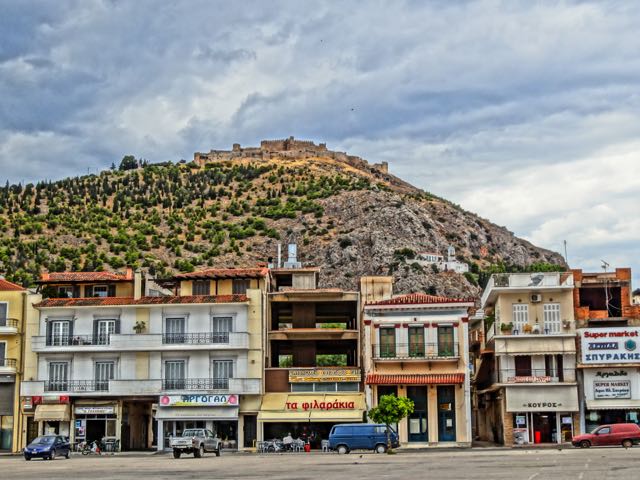 Our next stop was the modern town of
Argos
, the regional capital. It was not a planned
stop. I got us lost by making George take a
turn so I could get a good photo of the
ancient citadel without having to climb it.
But we found ourselves in the middle of a
gigantic open-air market full of farmers and
Gypsies selling vegetables, clothes, toys,
kitchen utensils and just about anything you
would find in Walmarts. I jumped out of the
car and ran around taking pictures. Some
people hid their faces, not wanting to be
photographed because they may have been
illegal immigrants or maybe they just didn't
like the way they looked that day. But some
people were very obliging, in particular a
group of Gypsy women selling bananas in the
town square. Argos has a museum and some archaeological stuff and some good restaurants though it is not on the beaten tourist path. But they have a great micro-brewery called Zeos and in the area called Neos Keos there is a river where all the fishing boats dock and if you cross the metal bridge there is a great fish taverna there. Our next stop was the modern town of
Argos
, the regional capital. It was not a planned
stop. I got us lost by making George take a
turn so I could get a good photo of the
ancient citadel without having to climb it.
But we found ourselves in the middle of a
gigantic open-air market full of farmers and
Gypsies selling vegetables, clothes, toys,
kitchen utensils and just about anything you
would find in Walmarts. I jumped out of the
car and ran around taking pictures. Some
people hid their faces, not wanting to be
photographed because they may have been
illegal immigrants or maybe they just didn't
like the way they looked that day. But some
people were very obliging, in particular a
group of Gypsy women selling bananas in the
town square. Argos has a museum and some archaeological stuff and some good restaurants though it is not on the beaten tourist path. But they have a great micro-brewery called Zeos and in the area called Neos Keos there is a river where all the fishing boats dock and if you cross the metal bridge there is a great fish taverna there.
|
Nafplio
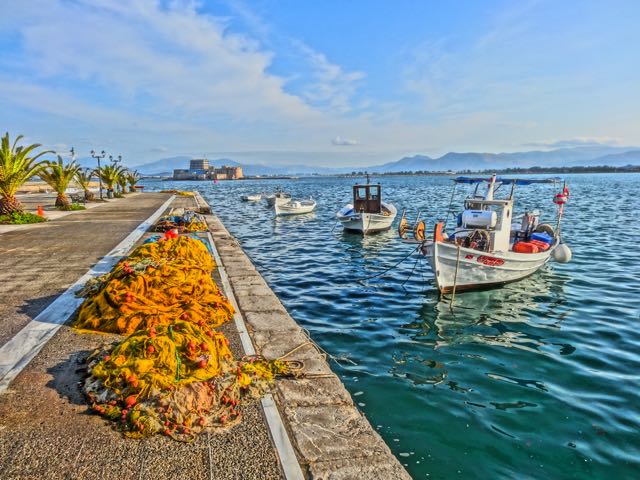 When we got to the beautiful historic city of
Nafplio, the Renaissance
cruise ship was visiting and the harbor was crawling
with Americans. (I mean that in a nice way) I was
sure George and I would be recognized and mobbed
and even though we had planned to stop for a
coffee, we decided not to stay and jumped back
into the car and sped away. Don't misunderstand
me. I like fame and recognition as much as the
next guy. But I was starving and I also wanted to
get to Epidavros while the theater was in full
sun. I didn't have time to sign autographs and
answer questions about Greece or turn down offers
of ouzo. I was trying to be purposeful and to
stick to a plan. I was surprised at the number of
cargo ships at the dock that were being filled
with oranges and would have enjoyed spending more
time gathering information about where all these
oranges were going. (Anyway because I go there fairly often Nafplio has been
covered in detail
on my Nafplion page
so just go
there if you want to read more and see a lot more photos)
When we got to the beautiful historic city of
Nafplio, the Renaissance
cruise ship was visiting and the harbor was crawling
with Americans. (I mean that in a nice way) I was
sure George and I would be recognized and mobbed
and even though we had planned to stop for a
coffee, we decided not to stay and jumped back
into the car and sped away. Don't misunderstand
me. I like fame and recognition as much as the
next guy. But I was starving and I also wanted to
get to Epidavros while the theater was in full
sun. I didn't have time to sign autographs and
answer questions about Greece or turn down offers
of ouzo. I was trying to be purposeful and to
stick to a plan. I was surprised at the number of
cargo ships at the dock that were being filled
with oranges and would have enjoyed spending more
time gathering information about where all these
oranges were going. (Anyway because I go there fairly often Nafplio has been
covered in detail
on my Nafplion page
so just go
there if you want to read more and see a lot more photos)
|
Epidavros
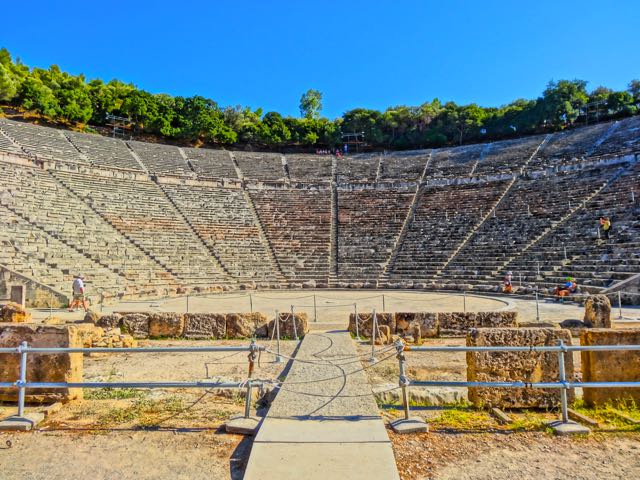 Unfortunately despite not sticking around long
enough to eat or find the secret of the oranges by
the time we got to
Epidavros
the theater was
in half sun which meant I could only photograph
half the theater. I could shoot either half but if
I took a picture of the sunny half the shady half
would not come out and if I shot the shady half
the sunny half would not come out. But besides a
Greek American couple that seemed like either
newlyweds or a couple having an affair, I was the
only one in the theater and in the end it did not matter because I came back again and took lots of photos. The theater of Epidavros
is the most perfect and best preserved of the
ancient theaters and if you stand where the actors
would have stood and drop a pebble, you can hear
it on the top row, provided that the place is not
full of tourists. It seats up to 14,000 people and
is still used in the summer for the Epidavros
Festival in July and August.
Unfortunately despite not sticking around long
enough to eat or find the secret of the oranges by
the time we got to
Epidavros
the theater was
in half sun which meant I could only photograph
half the theater. I could shoot either half but if
I took a picture of the sunny half the shady half
would not come out and if I shot the shady half
the sunny half would not come out. But besides a
Greek American couple that seemed like either
newlyweds or a couple having an affair, I was the
only one in the theater and in the end it did not matter because I came back again and took lots of photos. The theater of Epidavros
is the most perfect and best preserved of the
ancient theaters and if you stand where the actors
would have stood and drop a pebble, you can hear
it on the top row, provided that the place is not
full of tourists. It seats up to 14,000 people and
is still used in the summer for the Epidavros
Festival in July and August.
|
|
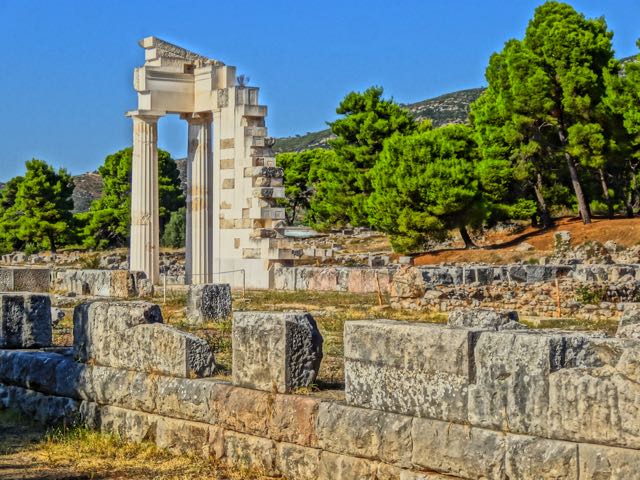 The site of Epidavros was a sanctuary to
Asklepios, with a healing spring and was one
of the major healing centers of the ancient
world. The ancient site is fairly extensive
and dates from around the 3rd and 4th Century
BC. There are ruins of several temples, a
stadium and buildings from ancient Greek and
Roman periods.
The site of Epidavros was a sanctuary to
Asklepios, with a healing spring and was one
of the major healing centers of the ancient
world. The ancient site is fairly extensive
and dates from around the 3rd and 4th Century
BC. There are ruins of several temples, a
stadium and buildings from ancient Greek and
Roman periods.
The museum was built in 1905 and houses some
of the artifacts found on the site including
statues and pottery and reconstructions of the
pediments of the ancient Asklepios and parts
of the temple. There is even a showcase of
medical instruments found on the site and
inscriptions of the accounts of miraculous
cures.
|
|
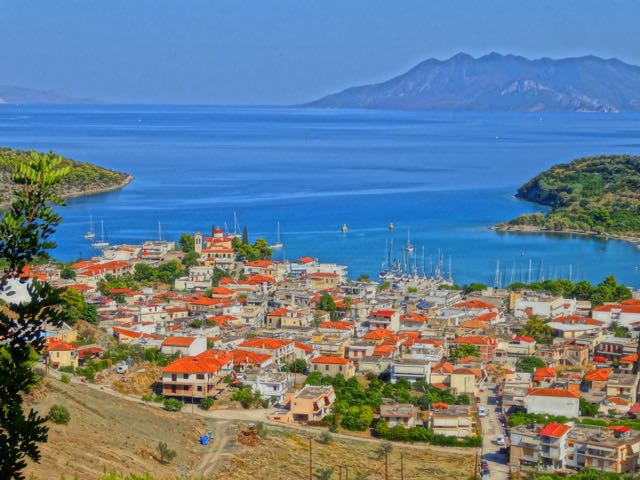 By this time I was starving. It was partially
my fault because I insisted on having lunch in
a quiet little seaside taverna in the town
of
Palea
Epidavros
, rather then somewhere along the way. By the
time we got to the small port, it was
partially in shade and we had to sit inside.
But we had a great late lunch of fried
kalamaraki, bakaliaro me skordalia and since
George was the designated driver I allowed
myself a glass of ouzo and then I drank
another one for him. The town itself was very
pretty but dead quiet in the winter. I could
hear a soccer game in the distance and every
so often a car would pass by but besides some
fishermen bringing in their catch or working
on their boats the place was empty. Like the
ancient Greeks I feel much happier when I can
see the sea.
By this time I was starving. It was partially
my fault because I insisted on having lunch in
a quiet little seaside taverna in the town
of
Palea
Epidavros
, rather then somewhere along the way. By the
time we got to the small port, it was
partially in shade and we had to sit inside.
But we had a great late lunch of fried
kalamaraki, bakaliaro me skordalia and since
George was the designated driver I allowed
myself a glass of ouzo and then I drank
another one for him. The town itself was very
pretty but dead quiet in the winter. I could
hear a soccer game in the distance and every
so often a car would pass by but besides some
fishermen bringing in their catch or working
on their boats the place was empty. Like the
ancient Greeks I feel much happier when I can
see the sea.
|
|
The road back to Athens (and hopefully the
evening's festivities) follows the south coast
of the Saronic Gulf and the sea is almost
always in sight. We stop on a hilltop cafe
that over looks Palea Epidavros so I can take
a photo for my wife, Andrea, who lived here
when she was a hippie migrant worker in the
seventies, sharing a shack with her boyfriend
and picking oranges to survive. In those days
the village was just a couple small huts on
the beach in a valley of olive groves. Now it
is a real town. In the summertime there are
boats that bring people for the festival in
the ancient theater.
|
|
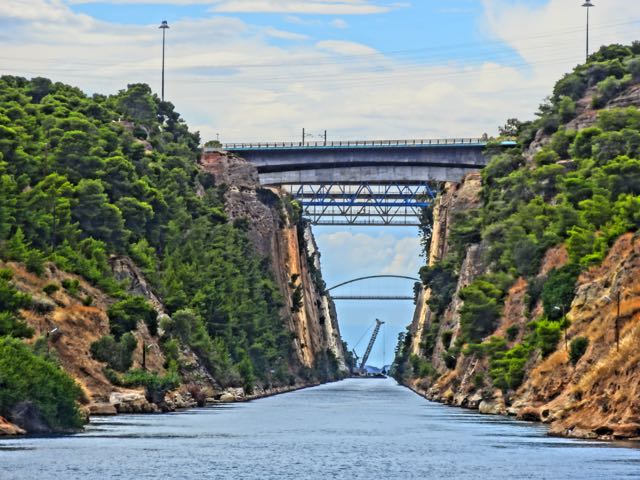 We had one last stop and that was at the
eastern entrance to the Corinth Canal, just beyond the
small town of Isthmia. There is a very old
submergible bridge there and George dropped me
off so I could walk across and he would meet
me on the other side. It was there that I saw
the most perfect cafe-ouzerie. This was the
kind of place where someone like me could sit
all day and all night watching the ships and
yachts enter and leave the Corinth canal,
starting with coffee in the morning, a late
afternoon ouzo and some retsina at night. Maybe that will be my next trip with
George.
But if you stop here and are lucky enough to see a ship come through, this bridge is one of the wonders of engineering. And this view of the Corinth Canal is pretty amazing.
We had one last stop and that was at the
eastern entrance to the Corinth Canal, just beyond the
small town of Isthmia. There is a very old
submergible bridge there and George dropped me
off so I could walk across and he would meet
me on the other side. It was there that I saw
the most perfect cafe-ouzerie. This was the
kind of place where someone like me could sit
all day and all night watching the ships and
yachts enter and leave the Corinth canal,
starting with coffee in the morning, a late
afternoon ouzo and some retsina at night. Maybe that will be my next trip with
George.
But if you stop here and are lucky enough to see a ship come through, this bridge is one of the wonders of engineering. And this view of the Corinth Canal is pretty amazing.
|
The remainder of the trip was a blur as I kept dosing off, even though we were only about an hour from the Hotel Attalos. George dropped me off, I went inside, took a shower and went to meet my pals at a taverna in Psiri. Just another day in Greece.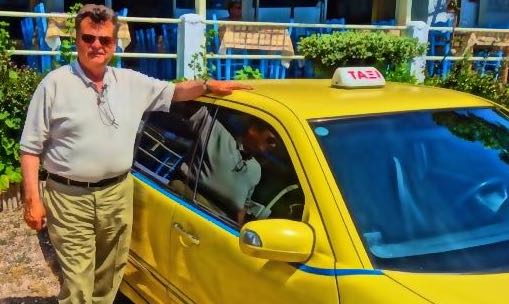 |
Useful Greece Information
|
|
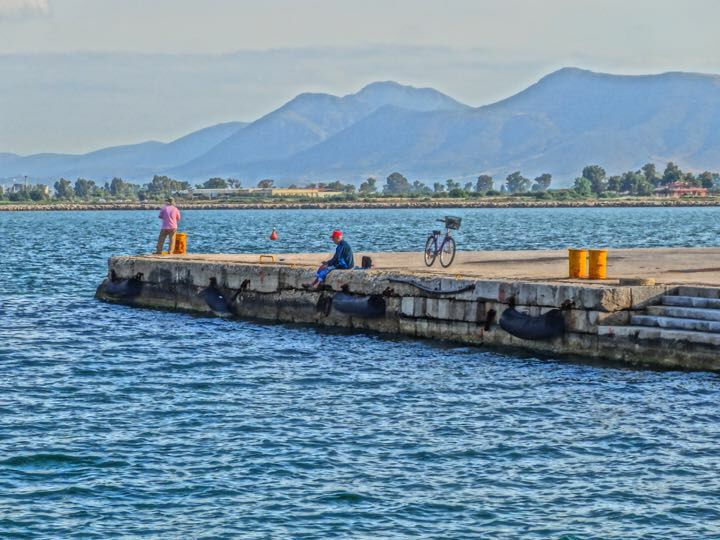 For information on booking George the Famous Taxi
Driver visit his website. You can also do this trip as an overnight and George will make all the hotel arrangements. Or you can do a multi night tour and visit Olympia, Delphi, Meteora,
or all over the Peloponessos and Greek Mainland. For information on booking George the Famous Taxi
Driver visit his website. You can also do this trip as an overnight and George will make all the hotel arrangements. Or you can do a multi night tour and visit Olympia, Delphi, Meteora,
or all over the Peloponessos and Greek Mainland.
You can also visit the Argolis on a tour
which can be arranged with your
Athens Travel
Agent
which is probably more economical if you are only one or two people. See Fantasy Travel's Tour Page
Try to visit Nemea where there are some fantastic ruins and the famous wine-roads where you can stop and sample some of the best wines in Greece from the wineries. See my Nemea Page
For more on the Argolis see Matt's Nafplion page and Matt's Argolis Page
For more daytrips from Athens see Athens Day Trips
Another excellent daytrip from Athens is Delphi and George can take you there too.
For groups too big for a taxi see Billy's Bus Tours
and Dennis's Limousine Tours. They are George's sons!
|